Funnel Stage Leakage
Decide whether a drop between stages is a normal tradeoff, a measurement issue, or a real growth constraint.
Decide whether a drop between stages is a normal tradeoff, a measurement issue, or a real growth constraint.
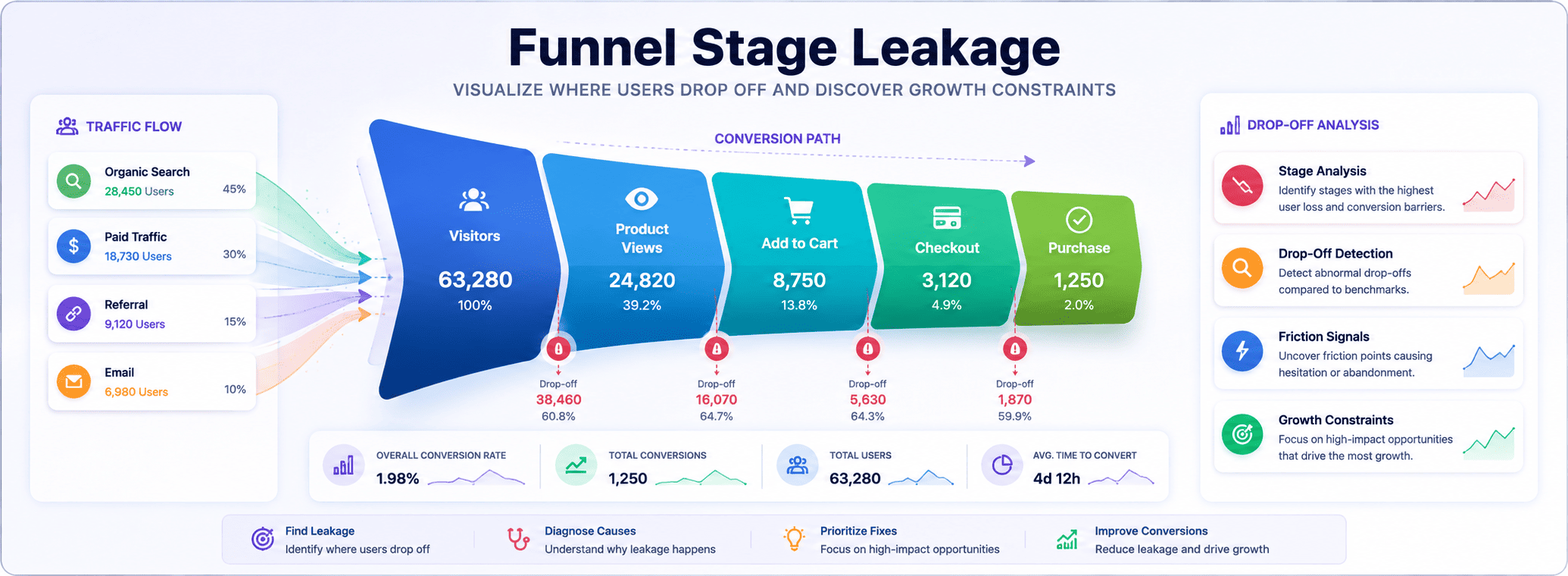
Three steps to a confident decision
Understand which business situation this page was built for and confirm it matches your current context.
Go item by item — each check has a clear pass/hold condition so you know exactly what qualifies.
Use the growth decision statement and analyst questions to brief your team and move forward with confidence.
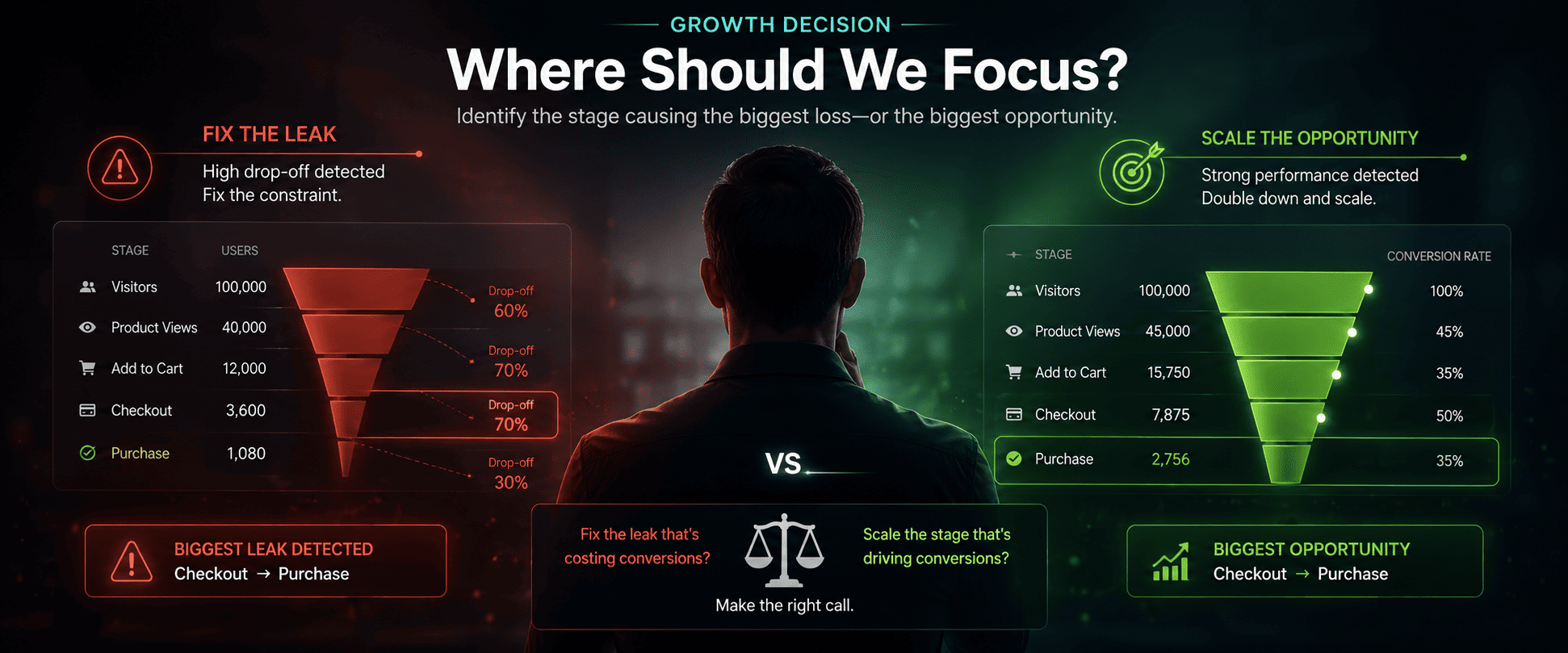
Funnel Stage Leakage
Decide whether a drop between stages is a normal tradeoff, a measurement issue, or a real growth constraint.
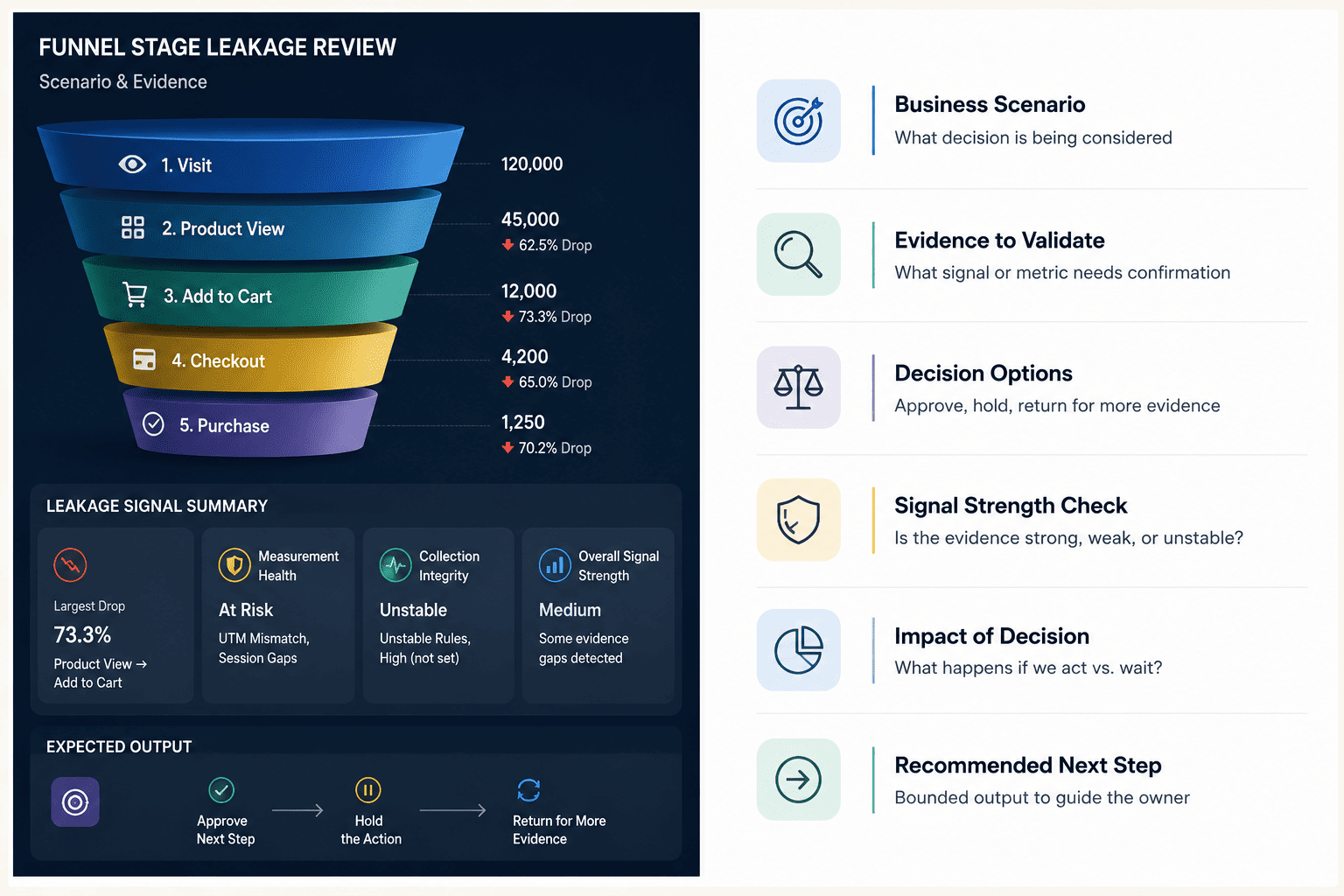
What this page helps a team decide
Analyze funnel stage leakage to identify whether conversion drop-offs are expected behavior, tracking errors, or growth bottlenecks. Validate evidence quality, ownership, and business impact before approving optimization decisions or allocating additional resources.
- Google Analytics.
- HubSpot.
- BigQuery.
- Company context.
What analysts ask before deciding
What decision is the conversion lead trying to make for funnel stage leakage: approve, hold, or send back for evidence?
Which input would make the marketer trust the funnel stage leakage read enough to change the page, offer, or experiment decision?
What caveat should stay visible before the team changes the page, offer, or experiment decision?
Who owns the next action if the review is approved, and what stays on hold if it is not?
What usually goes wrong
- The useful decision is not the biggest possible outcome; it is which input most changes the scenario and whether that input is measured well enough.
- Revenue-informed analysis should distinguish sales activity, cash timing, and durable customer quality.
- Some conversion problems are not page problems; they are execution problems around action, marketing cadence, delivery, or follow-up.
- Conversion volume only helps when the event matches the business decision and has enough downstream context.
What 10x.in checks
- Separate observed inputs from assumptions before treating a scenario as decision evidence.
- Connect campaign or funnel movement with commerce and payment context before judging quality.
- Separate a funnel leak from an operating leak, such as no follow-up, no promotion, weak delivery, or no owner.
- Separate decision-driving conversions from diagnostic events and caveated attribution signals.
OpenAnalyst should compare Stage evidence with analytics, CRM, warehouse, commerce, or payment support, name the caveat that could change the funnel stage leakage recommendation, and keep follow-up approval-gated.
FAQ
What mistake does the funnel math and scenario quality check prevent?
For Funnel Stage Leakage, this prevents a false-ready read: The useful decision is not the biggest possible outcome; it is which input most changes the scenario and whether that input is measured well enough. The reviewer should hold the action when the model is sensitive to an assumed number, keep the recommendation as a scenario until the source is verified.
What mistake does the commerce and revenue quality check prevent?
For Funnel Stage Leakage, this prevents a false-ready read: Revenue-informed analysis should distinguish sales activity, cash timing, and durable customer quality. The reviewer should hold the action when revenue quality or cash timing is missing, avoid turning source movement into a payback conclusion.
What mistake does the operating failure modes check prevent?
For Funnel Stage Leakage, this prevents a false-ready read: Some conversion problems are not page problems; they are execution problems around action, marketing cadence, delivery, or follow-up. The reviewer should hold the action when the operating owner or follow-up path is unclear, mark the recommendation as a process fix before a creative fix.
What should the reviewer approve after the checklist?
For Funnel Stage Leakage, the reviewer should approve only the next step tied to stage evidence. If the required evidence for stage evidence is not visible, the output should be a hold note.
Can OpenAnalyst make the change automatically?
No. For Funnel Stage Leakage, OpenAnalyst can draft the recommendation or follow-up, but execution stays approval-gated.
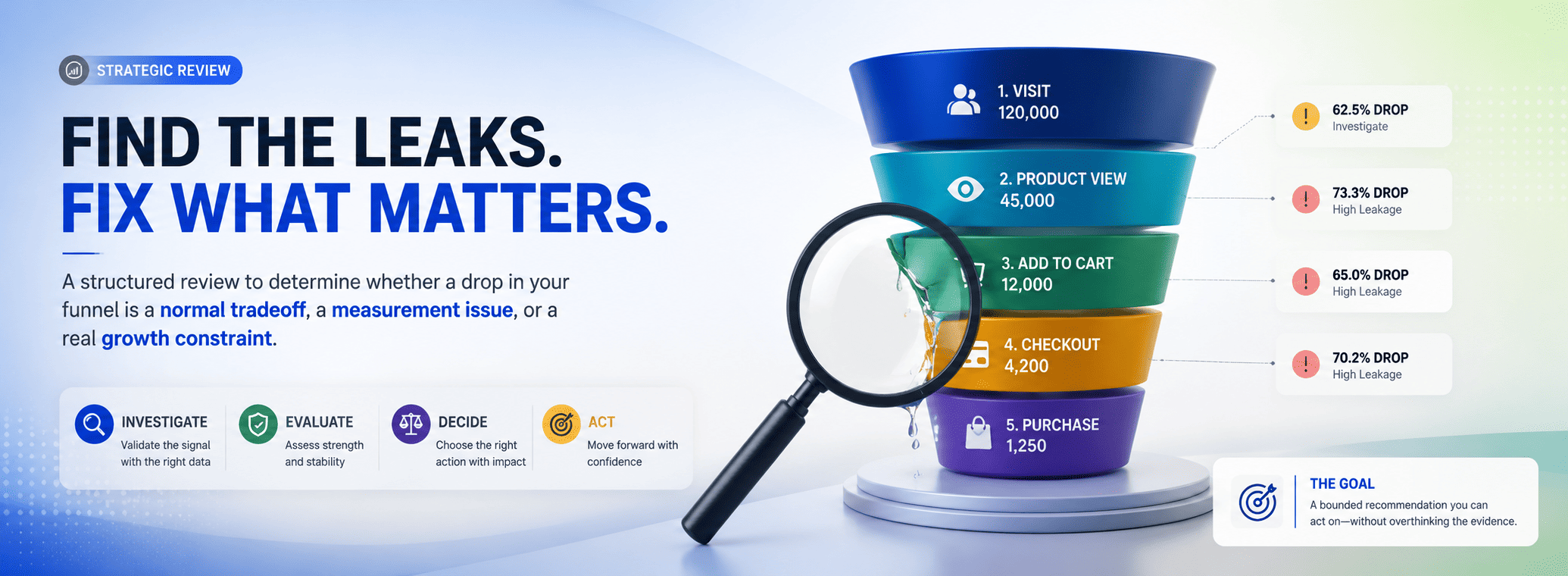
Funnel Stage Leakage Explained
Every conversion funnel loses users. Visitors leave websites, abandon forms, exit checkout flows, ignore follow-up emails, and postpone buying decisions. Some level of drop-off is expected because not every visitor is a qualified buyer. However, when a disproportionate number of users disappear between specific stages of the journey, growth teams face a problem known as funnel stage leakage. Understanding funnel stage leakage is one of the most important responsibilities in conversion analysis because it helps organizations identify where potential customers are being lost and where optimization efforts can produce the greatest business impact.
Many businesses focus heavily on traffic acquisition. Teams launch advertising campaigns, invest in search engine optimization, create content, expand partnerships, and increase media spending. While acquisition is important, traffic alone does not create growth. Growth occurs when users successfully move through the funnel and complete meaningful actions. A business that doubles traffic while maintaining severe leakage may see little improvement in revenue. Conversely, a business that reduces leakage at critical stages can often achieve significant growth without increasing acquisition costs.
Funnel stage leakage analysis provides a structured framework for understanding how users progress through a conversion journey, where they abandon that journey, and what evidence supports the causes behind those losses. Rather than relying on assumptions, growth teams can use leakage analysis to identify bottlenecks, prioritize experiments, and improve conversion efficiency across the funnel.
What Is Funnel Stage Leakage?
Funnel stage leakage refers to the loss of users between major stages of a conversion funnel. Every funnel contains a sequence of steps that users are expected to complete on their path toward a desired outcome. These steps vary depending on the business model, but they generally represent increasing levels of intent and engagement.
For an ecommerce business, the funnel may include website visitors, product viewers, add-to-cart users, checkout initiators, and completed purchases. For a SaaS company, the funnel may consist of visitors, signups, activated users, trial users, and paying customers. For a lead-generation business, the funnel may progress from visitor to lead, qualified lead, sales opportunity, and customer.
Leakage occurs whenever users fail to move from one stage to the next. The objective of leakage analysis is not to eliminate all drop-off. Some users will naturally leave because they are not the right fit, lack purchase intent, or are simply browsing. The goal is to determine whether losses are larger than expected and whether those losses are caused by avoidable friction.
Why Funnel Leakage Matters
Funnel leakage directly influences growth efficiency. Every user who exits the funnel before reaching a conversion milestone represents lost opportunity. If a large percentage of users abandon the journey at a particular stage, improving that stage may create greater business impact than increasing traffic volume.
Consider a store that receives one hundred thousand monthly visitors. If only a small percentage of those visitors reach product pages, the issue may not be traffic volume but engagement quality. If thousands add products to their carts but only a few complete checkout, the problem may exist later in the funnel. Without leakage analysis, teams may continue investing resources in acquisition while the actual growth constraint remains unresolved.
Leakage analysis also improves prioritization. Growth teams often manage large backlogs containing dozens of ideas and optimization opportunities. Understanding where users are leaking allows teams to focus effort where the potential impact is highest. Instead of debating which initiative deserves attention, teams can use evidence from funnel performance to guide decisions.
How Funnel Stages Are Structured
Most conversion funnels follow a progression that reflects increasing commitment from the user. Although terminology differs across organizations, the underlying structure remains similar. Users move from awareness to interest, from interest to consideration, from consideration to intent, and eventually to conversion.
A simplified ecommerce funnel may include:
- Website Visitor
- Category Viewer
- Product Viewer
- Add to Cart
- Begin Checkout
- Purchase
A SaaS funnel may include:
- Website Visitor
- Account Signup
- Product Activation
- Trial User
- Paid Subscriber
Each stage transition creates an opportunity for users to continue or leave. Leakage analysis focuses on understanding the size and cause of those losses.
Common Sources of Funnel Stage Leakage
Poor Traffic Quality
One of the most common causes of leakage originates before users even enter the funnel. Advertising campaigns may target the wrong audience. Search traffic may arrive for unrelated queries. Referral sources may attract visitors with little purchase intent. When traffic quality is weak, users often leave early because the experience does not match their expectations.
Weak Value Proposition
Users need to understand why a product or service matters. If value communication is unclear, visitors may fail to see relevance and abandon the journey. Weak messaging frequently causes leakage between awareness and consideration stages.
User Experience Friction
Navigation problems, confusing layouts, poor mobile experiences, slow-loading pages, and broken interactions all contribute to leakage. Even small usability issues can significantly reduce progression rates when they affect large user populations.
Trust Deficits
Trust plays an important role throughout the funnel. Users may hesitate when reviews are missing, policies are unclear, security signals are weak, or company credibility appears questionable. Trust-related leakage often becomes visible near checkout or lead submission stages.
Offer Misalignment
Visitors may understand the product and trust the company but still choose not to convert if pricing, packaging, shipping costs, or commitment requirements do not align with expectations. Offer-related leakage frequently appears during consideration and intent stages.
How Growth Teams Measure Leakage
Measuring leakage begins by defining meaningful funnel stages. Each stage should represent a measurable user action that reflects progression toward business value. Once stages are established, analysts calculate the percentage of users moving from one stage to the next.
For example, if ten thousand users view a product and two thousand add that product to their cart, the progression rate is twenty percent. If only five hundred of those users complete checkout, analysts can identify where the largest losses occur and investigate accordingly.
Modern analytics platforms provide several ways to measure these transitions. Common tools include Google Analytics, GA4 Funnel Exploration, Shopify Analytics, Mixpanel, Amplitude, BigQuery, and internal reporting systems. The objective is not simply to measure conversion rates but to understand the movement between stages.
Diagnosing the Causes Behind Leakage
Quantitative analytics identify where users leave, but they rarely explain why. Effective leakage analysis combines behavioral evidence with numerical data. Growth teams often supplement funnel reports with qualitative research to understand user intent and friction.
Useful evidence sources include session recordings, heatmaps, customer interviews, survey responses, support conversations, sales calls, usability tests, and experiment history. Each source provides a different perspective on customer behavior.
For example, analytics may reveal significant abandonment during checkout. Session recordings may show users repeatedly interacting with shipping information. Customer surveys may mention unexpected fees. Together, these findings provide a stronger explanation than conversion data alone.
Strong diagnosis requires multiple forms of evidence. A single data point rarely provides enough context to justify major business decisions.
Using Leakage Analysis to Prioritize Optimization
One of the most valuable outcomes of leakage analysis is prioritization. Growth teams often struggle to decide which opportunities deserve immediate attention. Funnel performance provides an objective framework for making those decisions.
If a large percentage of users view products but very few add items to their carts, product-page optimization may become the highest-priority initiative. If cart activity remains strong while checkout completion falls significantly below expectations, checkout experience improvements may deserve greater focus.
Prioritization becomes even more powerful when combined with business impact estimates. Analysts can evaluate how many users are affected, how much revenue is associated with the stage, and how difficult improvements may be to implement. This approach helps teams allocate resources more effectively.
Common Mistakes When Analyzing Leakage
Many organizations assume that the stage with the largest percentage drop-off automatically deserves attention. While large losses can indicate problems, context matters. Some funnel stages naturally experience higher abandonment rates than others. Analysts should compare performance against historical baselines, audience expectations, and business goals before drawing conclusions.
Another common mistake involves focusing exclusively on percentages. A stage affecting ten thousand users may deserve more attention than a stage affecting one hundred users, even if the percentage loss appears smaller. Volume and business impact should always be considered alongside conversion rates.
Teams also frequently confuse symptoms with causes. High checkout abandonment may actually originate from poor traffic quality, misleading advertising, or weak product positioning. Effective analysis looks beyond visible outcomes and investigates underlying drivers.
Funnel Leakage Across Different Business Models
Although the concept remains consistent, leakage appears differently across industries. Ecommerce businesses often focus on product discovery, cart creation, and checkout completion. SaaS companies may concentrate on activation and subscription conversion. Lead-generation organizations frequently analyze qualification rates and sales progression.
Regardless of the business model, the underlying objective remains the same: understand where users leave the journey and determine whether those losses can be reduced through evidence-based improvements.
The strongest organizations treat leakage analysis as an ongoing process rather than a one-time report. Customer behavior changes over time, traffic sources evolve, products improve, and market conditions shift. Continuous monitoring helps teams identify emerging problems before they become significant business constraints.
Conclusion
Funnel stage leakage is one of the most important concepts in conversion analysis because it reveals where potential customers leave the journey before reaching meaningful outcomes. Instead of focusing exclusively on traffic growth or overall conversion rate, organizations can examine individual stage transitions and identify the specific points where opportunity is being lost.
When supported by analytics, behavioral research, customer feedback, and experimentation, leakage analysis becomes a powerful framework for growth decision-making. The objective is not to eliminate every drop-off but to distinguish natural abandonment from avoidable loss. By understanding where leakage occurs and why it happens, growth teams can prioritize improvements more effectively, increase conversion efficiency, and create a stronger foundation for sustainable growth.