Why buyer problem prioritization matters
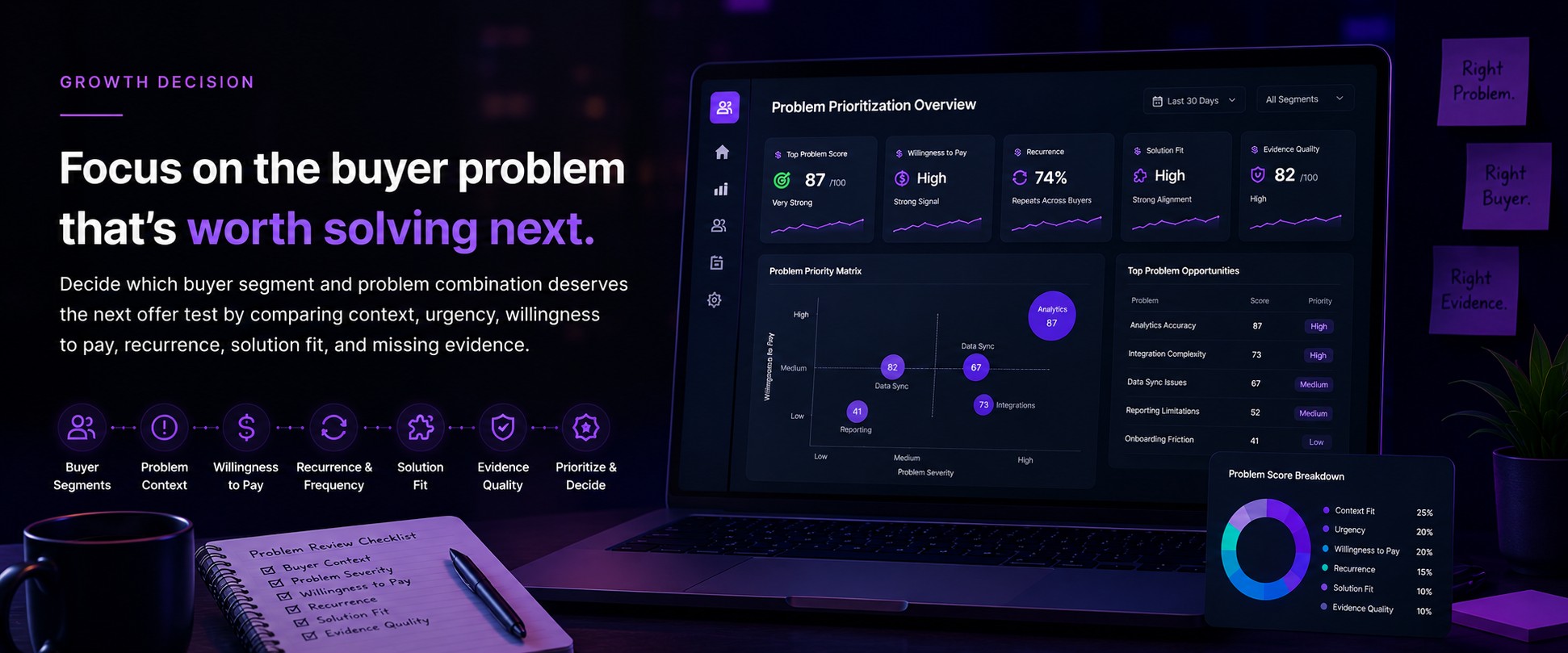
Buyer problem prioritization helps a growth team decide which buyer segment and problem combination deserves the next offer test. The goal is not to choose the most interesting idea. The goal is to identify the problem that has enough urgency, context, willingness to pay, recurrence, and solution fit to justify action.
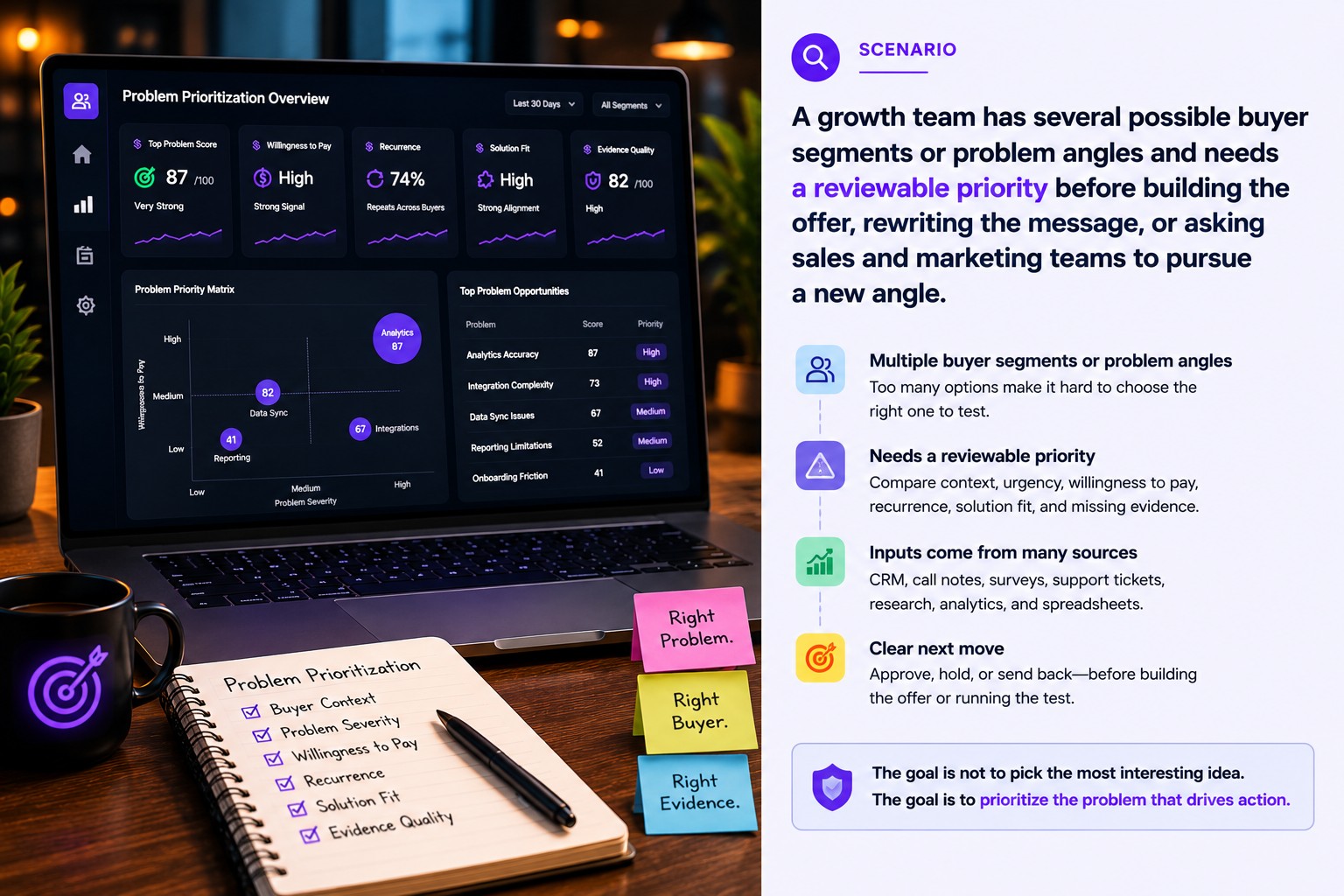
This review is useful when the team has several possible buyer segments, pain points, or message angles but needs a clear priority before building an offer, rewriting a page, creating a campaign, or asking sales and marketing teams to pursue a new angle.
What this workflow helps decide
The core decision is whether to approve, hold, or send back a buyer problem priority. A strong recommendation should explain which buyer segment matters, which problem should be tested next, what evidence supports the choice, and what caveat still needs to stay visible.
If the evidence is incomplete, the team should not move straight into offer creation or experiment execution. The correct output is a hold note, research request, or scenario memo that explains what must be verified first.
Inputs needed for the review
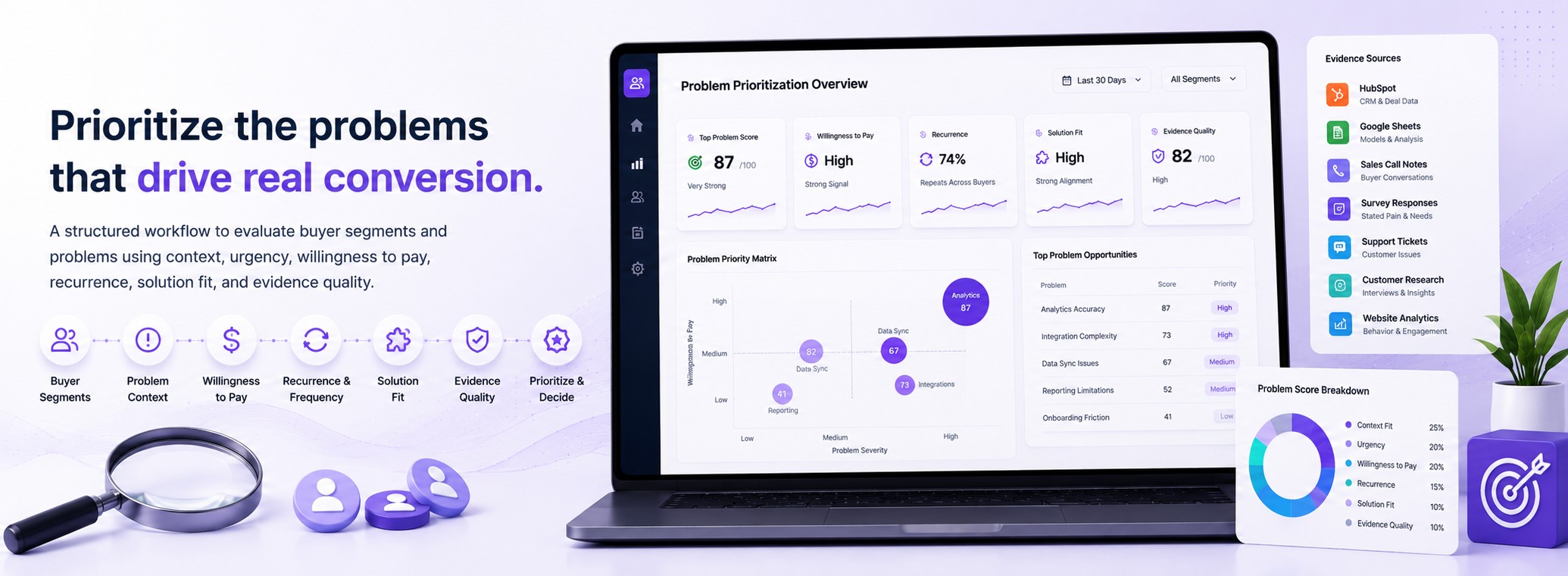
- HubSpot: Use CRM data to understand deal stage, segment quality, sales notes, conversion movement, and customer fit.
- Google Sheets: Review scoring models, prioritization tables, assumptions, and supporting calculations.
- Sales call notes: Look for repeated buyer objections, urgency signals, budget signals, and language buyers use to describe the problem.
- Survey responses: Identify stated pain points, willingness to act, desired outcomes, and problem frequency.
- Support tickets: Review recurring frustrations, implementation barriers, unmet needs, and post-purchase problems.
- Customer research: Compare qualitative evidence across buyer context, pain severity, existing alternatives, and decision triggers.
- Website analytics: Check which pages, paths, offers, and conversion points already show demand or friction.
Step 1: Define the buyer context
The first step is to make the buyer context specific enough for the team to design a relevant offer. A broad segment like “small businesses” or “marketing teams” is usually too vague. The reviewer should identify the buyer type, business context, current situation, and trigger that makes the problem urgent.
A strong buyer context explains who the buyer is, what they are trying to achieve, what constraint is blocking progress, and why the problem matters now. Without this context, the team may build an offer that sounds useful but does not match a real decision moment.
- Who is the buyer?
- What situation are they in?
- What problem are they trying to solve?
- Why does the problem matter now?
- What happens if they do nothing?
Step 2: Separate interesting problems from painful problems
Not every problem deserves an offer test. Some problems are interesting to discuss but not painful enough to motivate action. The reviewer should separate nice-to-have problems from problems that create cost, lost revenue, operational friction, time waste, risk, or missed opportunity.
A painful problem usually has consequences. The buyer may already be spending time, money, or attention trying to solve it. They may complain about it in sales calls, raise it in support tickets, search for alternatives, or show conversion interest when the problem is named clearly.
Step 3: Check willingness-to-pay signals
Willingness to pay is one of the most important signals in buyer problem prioritization. A problem may be real, recurring, and urgent, but still not worth testing if the buyer is unlikely to pay for a solution or change behavior.
The reviewer should look for evidence that buyers already spend money, effort, or attention to solve the problem. This can include current tools, manual workarounds, consulting spend, team time, lost deals, support burden, or repeated requests for help.
- Do buyers already pay for a related solution?
- Are they using manual workarounds?
- Does the problem affect revenue, cost, speed, risk, or customer experience?
- Have buyers asked for help solving it?
- Does the problem appear in sales, support, or research evidence?
Step 4: Review recurrence and frequency
A problem that happens once may not justify a durable offer. A problem that repeats across buyers, segments, or lifecycle moments is more likely to deserve prioritization.
The reviewer should check whether the problem appears repeatedly in call notes, survey responses, support tickets, website behavior, or CRM patterns. Recurrence makes the problem easier to validate and easier to turn into a repeatable offer or campaign angle.
Step 5: Confirm solution fit
The team should only prioritize a buyer problem if it can credibly solve the problem for the selected buyer. A painful problem is not automatically a good opportunity if the company lacks the product, expertise, delivery path, or proof needed to solve it.
The reviewer should compare the problem with the team’s actual ability to deliver value. If the solution fit is weak, the recommendation should remain held or be reframed around a more credible problem.
Step 6: Separate evidence from assumptions
Buyer problem prioritization often involves incomplete information. That is acceptable as long as the recommendation clearly separates observed inputs from assumptions.
Observed inputs may include CRM data, sales call notes, survey responses, support tickets, customer research, and website analytics. Assumptions may include estimated urgency, assumed budget, guessed segment size, or expected conversion impact.
The reviewer should not treat an assumption as decision evidence. If the model is sensitive to an assumed number, the recommendation should remain a scenario until the source is verified.
Step 7: Score the problem without hiding caveats
A prioritization score can help compare options, but it should not hide uncertainty. The reviewer should make the caveat visible whenever missing evidence could change the decision.
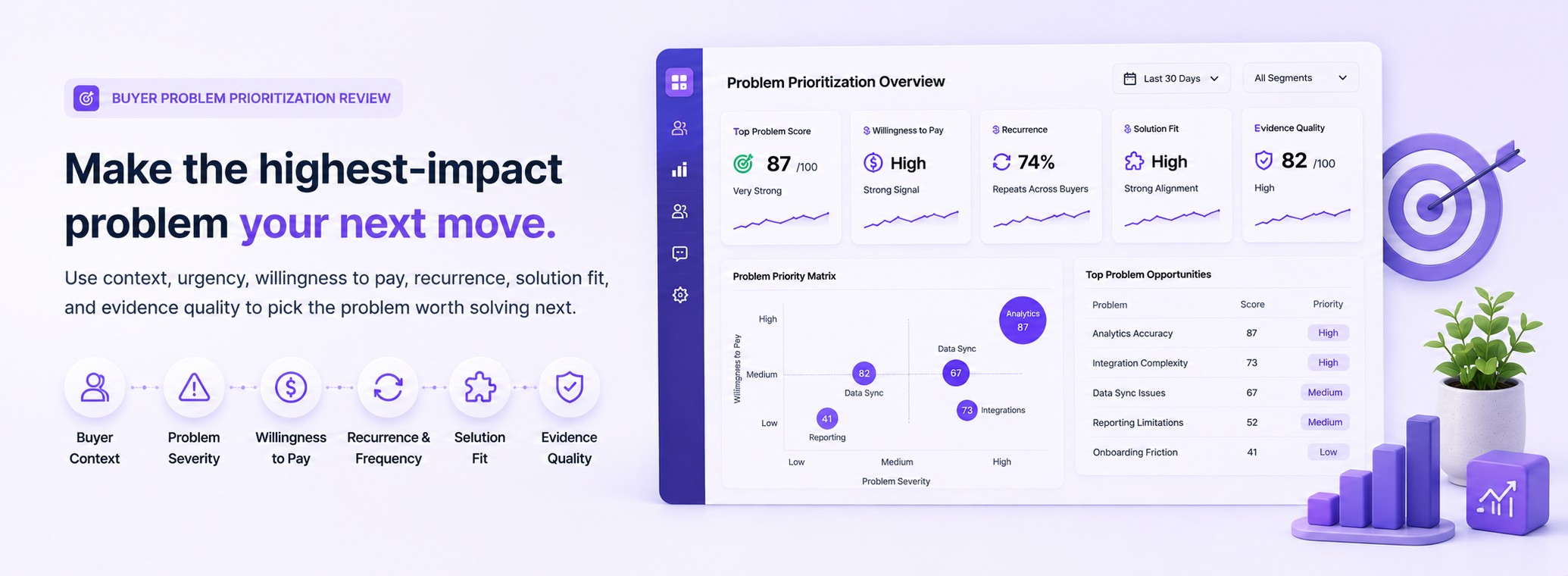
A useful score should compare buyer context, problem severity, willingness to pay, recurrence, solution fit, and evidence quality. The score should support the decision, not replace the judgment.
- Buyer context: Is the segment specific and actionable?
- Problem severity: Is the problem painful enough to motivate action?
- Willingness to pay: Is there evidence of spend, effort, or urgency?
- Recurrence: Does the problem appear repeatedly?
- Solution fit: Can the team credibly solve it?
- Evidence quality: Are the sources strong enough to support action?
Step 8: Decide what changes and what stays held
The final output should not be generic advice. It should state what changes, what stays held, and what evidence would make the recommendation stronger.
If the buyer problem is approved, the team can move into an offer test, page rewrite, campaign angle, or experiment plan. If the evidence is incomplete, the next action should be a research step, source review, or scenario update.
OpenAnalyst should review Buyer Problem Prioritization Review, compare the decision evidence with the caveats, and keep the next recommendation approval-gated until the reviewer accepts it.
Recommended decision outcomes
- Approve: The buyer segment and problem combination has enough context, urgency, willingness to pay, recurrence, solution fit, and evidence quality to justify the next offer test.
- Hold: The problem may be promising, but the evidence is incomplete or the caveat is large enough to change the action.
- Send back: The team needs better buyer context, stronger source evidence, clearer willingness-to-pay signals, or a more credible solution fit before moving forward.
What should remain approval-gated
OpenAnalyst can draft the recommendation, research summary, prioritization memo, or follow-up request. Execution should remain approval-gated. The tool should not automatically change the page, build the offer, launch the experiment, or redirect sales and marketing activity until the reviewer accepts the evidence and caveats.
Final review checklist
- Is the buyer segment specific enough to design a relevant offer?
- Is the problem painful enough to motivate action?
- Is there evidence of willingness to pay?
- Does the problem recur across more than one source?
- Can the team credibly solve the problem?
- Are observed inputs separated from assumptions?
- Is the recommendation tied to a clear next action?
- Are caveats visible before the team changes the page, offer, or experiment?
- Does the reviewer know what is approved, held, or sent back?