CRO Practice Update Readiness
Decide whether the CRO practice has current enough metrics, research, experiment portfolio context, and review ownership before updating optimization reco.
Decide whether the CRO practice has current enough metrics, research, experiment portfolio context, and review ownership before updating optimization recommendations.
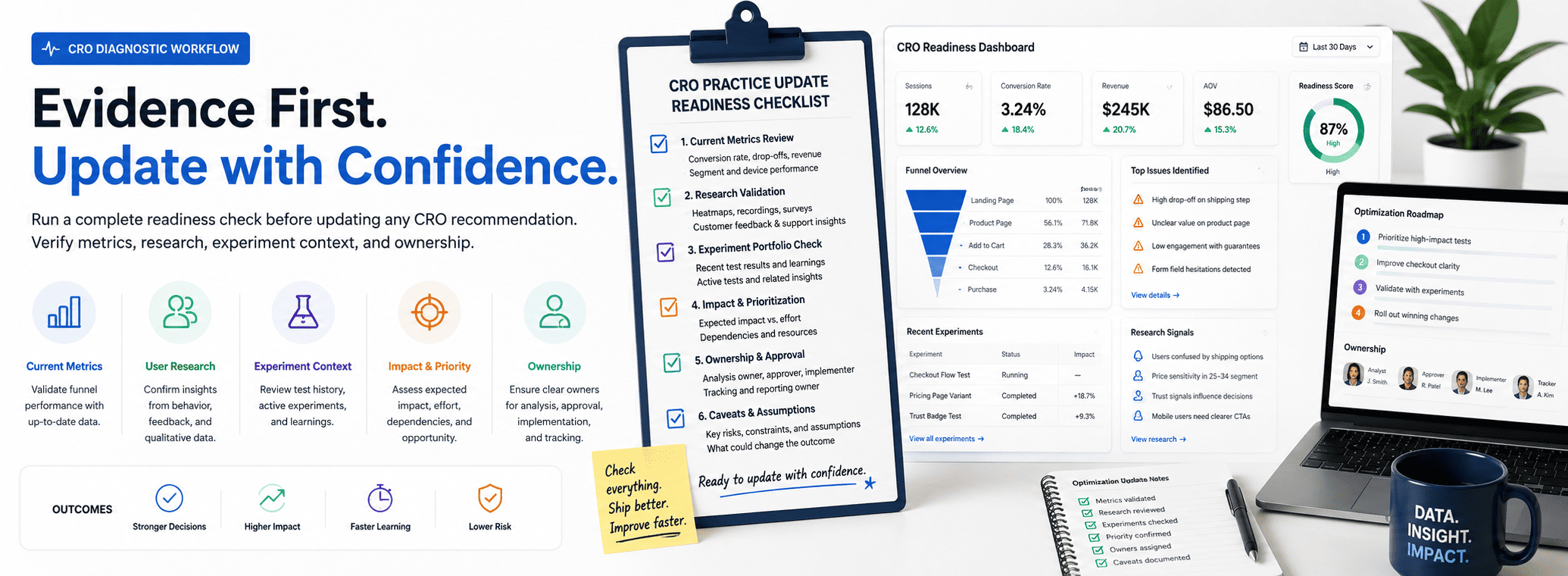
Three steps to a confident decision
Understand which business situation this page was built for and confirm it matches your current context.
Go item by item — each check has a clear pass/hold condition so you know exactly what qualifies.
Use the growth decision statement and analyst questions to brief your team and move forward with confidence.
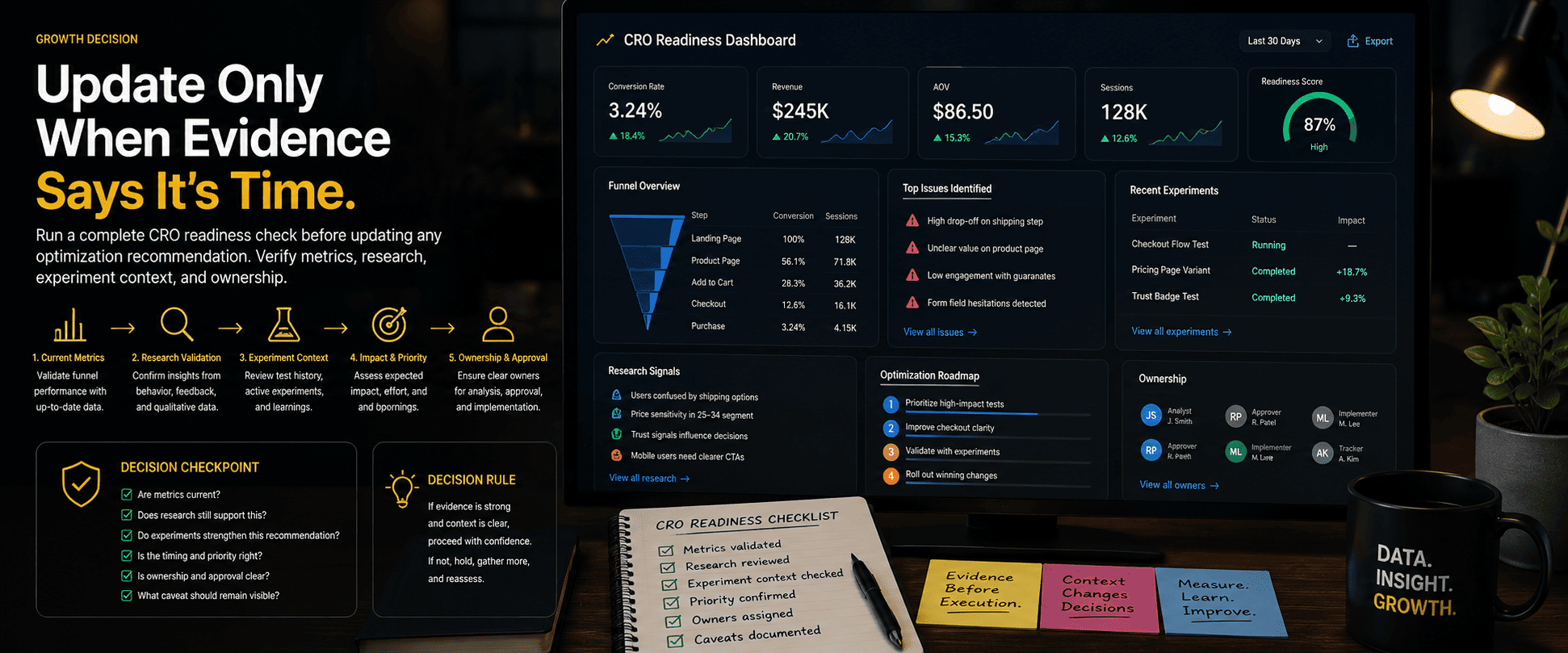
CRO Practice Update Readiness
Decide whether the CRO practice has current enough metrics, research, experiment portfolio context, and review ownership before updating optimization recommendations.
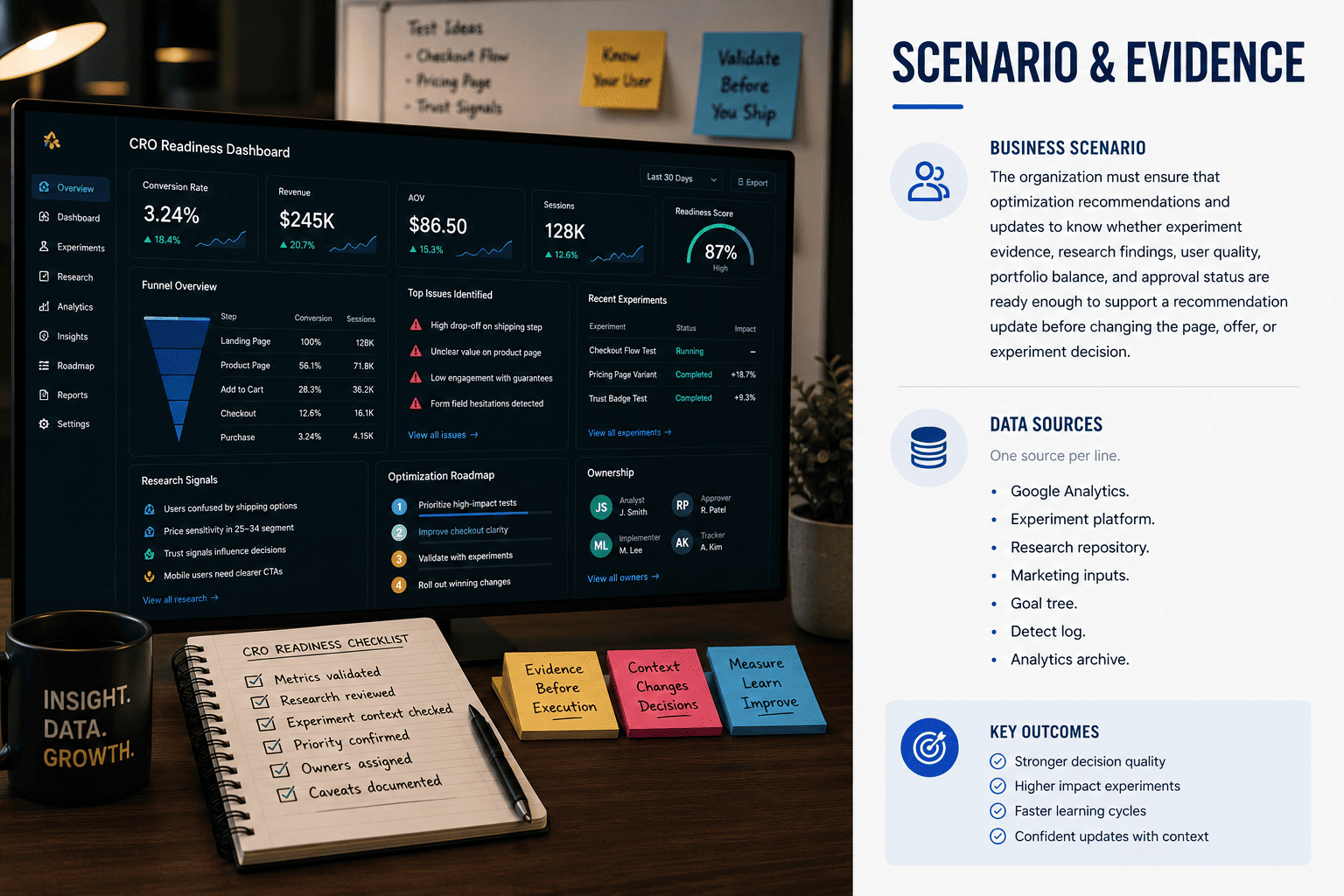
What this page helps a team decide
The conversion lead needs to refresh optimization recommendations and wants to know whether experiment value metrics, research freshness, idea quality, portfolio balance, and approval state are ready enough to support a recommendation update before changing the page, offer, or experiment decision.
- Google Analytics.
- Experiment platform.
- Research repository.
- Workshop notes.
- Goal tree.
- Retest log.
- Analytics warehouse.
What analysts ask before deciding
What decision is the conversion lead trying to make for cro practice update: approve, hold, or send back for evidence?
Which input would make the marketer trust the cro practice update read enough to change the page, offer, or experiment decision?
What caveat should stay visible before the team changes the page, offer, or experiment decision?
Who owns the next action if the review is approved, and what stays on hold if it is not?
What usually goes wrong
- The conversion lead treats metric freshness and value context as settled before checking the recommendation is based on current value and conversion evidence rather than an old headline win.
- The recommendation skips the research currency caveat, so the next step looks safer than the evidence allows.
- Follow-up moves forward before the experiment portfolio balance approval rule is accepted.
What 10x.in checks
- Confirm that the recommendation is based on current value and conversion evidence rather than an old headline win.
- Review whether the research still describes the current page, offer, audience, and buyer objection.
- Check whether the next recommendation fits a balanced testing program rather than over-favoring only easy changes.
- Decide whether the recommendation needs retesting, a hold note, or approval before implementation.
- Separate observed inputs from assumptions before treating a scenario as decision evidence.
OpenAnalyst should review CRO Practice Update Readiness, compare the decision evidence with the caveats, and keep the next recommendation approval-gated until the reviewer accepts it.
FAQ
What evidence must be refreshed before the CRO practice recommendation changes?
Refresh the value metric, goal tree, research source, portfolio balance, and approval state before changing the recommendation. In this review, the answer should be tied back to the operating rule rather than left as advice. The analyst should state what changes, what stays held, and what evidence would make the recommendation stronger.
When should a CRO practice update stay on hold?
Hold the update when the metric window is stale, research no longer matches the current page or audience, or the backlog is not balanced enough to support the next test. In this review, the answer should be tied back to the operating rule rather than left as advice. The analyst should state what changes, what stays held, and what evidence would make the recommendation stronger.
How should the reviewer separate a real update from a retest request?
Approve a real update only when current value evidence, research, and owner context agree. Use a retest request when the prior result is fragile, old, or missing risk controls. In this review, the answer should be tied back to the operating rule rather than left as advice. The analyst should state what changes, what stays held, and what evidence would make the recommendation stronger.
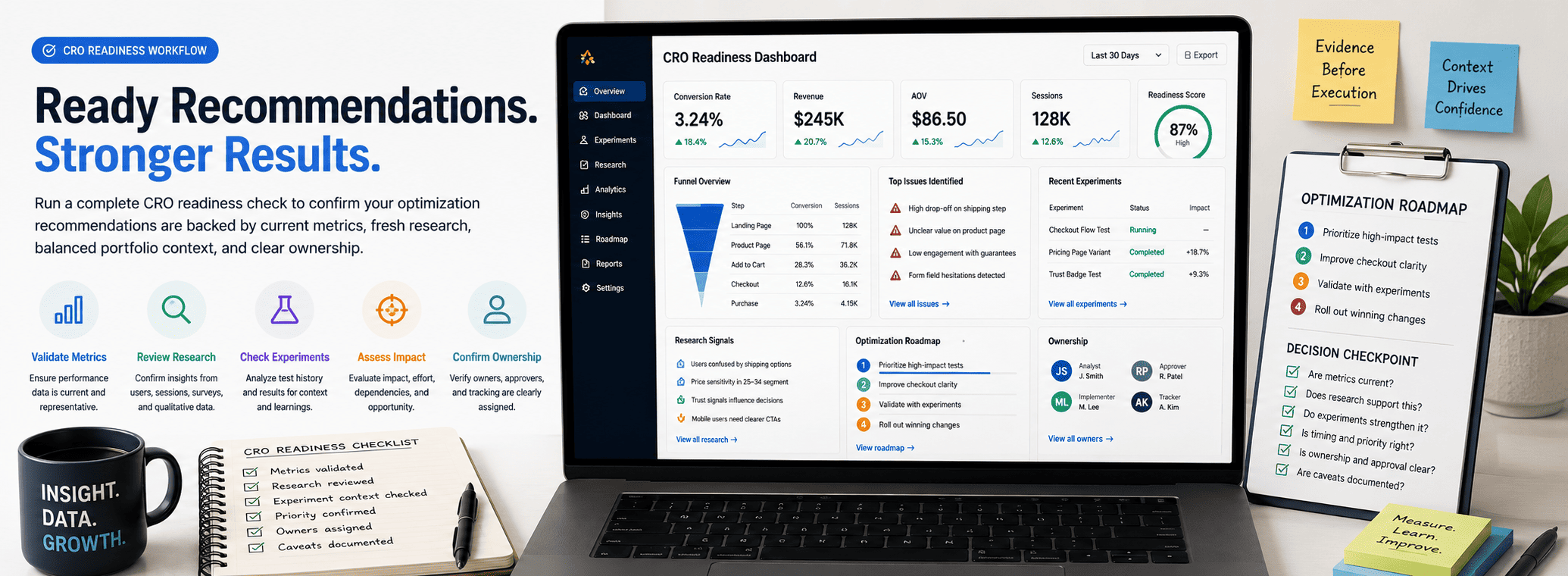
CRO Practice Update Readiness
CRO recommendations should only change when the evidence is current enough to support a new decision. A test result, customer insight, or analytics pattern may have been useful when it was first captured, but funnel behavior changes over time. Traffic sources shift, page layouts update, audience expectations move, and prior experiments may no longer describe the current conversion path.
The CRO Practice Update Readiness workflow helps conversion teams decide whether an optimization recommendation should be approved, held, or sent back for evidence before the page, offer, or experiment plan changes. The review checks whether metrics, research, experiment portfolio context, value evidence, and ownership are strong enough to support the update.
The goal is not to refresh every recommendation automatically. The goal is to make sure the next CRO recommendation is based on current value and conversion evidence rather than an old headline win.
What This Workflow Decides
The workflow answers one practical question: is the CRO practice ready to update its optimization recommendations? A recommendation should move forward only when current metrics, research, test history, portfolio balance, and approval state all support the same next action.
- Approve: Current value evidence, research, experiment context, and ownership support the recommendation update.
- Hold: The metric window, research source, or approval state is too stale or incomplete.
- Send back for evidence: The team needs updated analytics, research notes, portfolio review, or owner approval.
- Retest: The prior result is fragile, old, or missing the controls needed for confident implementation.
Refresh Value And Conversion Metrics
The first readiness check is metric freshness. A recommendation should not rely on an old conversion lift if the current funnel, audience, or offer has changed. The reviewer should confirm that the performance window reflects the current page experience and business goal.
- Landing page conversion rate
- Lead form completion or checkout completion
- Average order value or revenue per visitor
- Device and traffic-source performance
- Segment-level conversion movement
- Goal tree alignment with the current business objective
If the value metric changed since the recommendation was created, the team should re-evaluate the update before implementation. A recommendation that improved click-through may not still be valid if downstream revenue, lead quality, or checkout completion now tells a different story.
Check Research Currency
Research explains why users behave the way they do. Metrics show movement, but research helps the team understand friction, belief gaps, objections, and decision context. Before updating a CRO recommendation, the reviewer should confirm that the research still describes the current page, offer, audience, and buyer objection.
- Session recordings and heatmaps
- Survey responses and customer interviews
- Sales call notes and support themes
- Workshop notes and stakeholder observations
- Friction notes tied to the current page version
Research should stay caveated when it describes an older experience, a different audience, or a prior version of the offer. For example, if a recommendation was built around CTA confusion but recent behavior shows users now find the CTA easily, the update may need a new evidence review instead of approval.
Review Experiment Portfolio Context
A CRO practice update should not evaluate one idea in isolation. The recommendation must fit the broader experiment portfolio. A team may over-prioritize easy copy changes while ignoring deeper offer, pricing, checkout, or belief-gap problems. The reviewer should check whether the next recommendation supports a balanced testing program.
- Recent A/B test results and confidence labels
- Past losing variants and repeated ideas
- Retest log for fragile or old findings
- Experiment backlog balance across copy, UX, offer, pricing, and funnel steps
- Current tests that may conflict with the proposed update
This prevents the team from repeating a test that already failed or approving a recommendation that is easy to ship but not important enough to move the funnel. If the portfolio is not balanced enough to support the next test, the update should stay held.
Separate Observed Inputs From Assumptions
CRO recommendations often mix observed evidence with interpretation. That is normal, but the distinction should be visible. The reviewer should separate what was observed in analytics, research, and experiment results from what the team assumes about buyer motivation or business impact.
- What behavior was directly observed?
- What customer problem was confirmed through research?
- What value metric supports the recommendation?
- Which parts of the recommendation are still assumptions?
- What evidence would weaken or reverse the update?
If the recommendation depends on an assumption that has not been verified, the correct output may be a retest request or hold note rather than an implementation approval.
Decide Whether To Update, Retest, Or Hold
The review should translate evidence into one clear next action. A real practice update is appropriate when current value evidence, research, and owner context agree. A retest is appropriate when the prior result is old, fragile, or missing risk controls. A hold is appropriate when the metric window is stale, research no longer matches the current page, or portfolio context is incomplete.
- Update: The recommendation is current, evidence-backed, and ready for implementation or roadmap change.
- Retest: The idea is still plausible, but confidence is not strong enough for direct implementation.
- Hold: The team needs fresher metrics, research, or portfolio review before acting.
- Retire: The recommendation no longer fits the current page, offer, audience, or goal tree.
Confirm Ownership And Approval
Optimization work stalls or becomes risky when ownership is unclear. Before approving a CRO practice update, the reviewer should confirm who owns analytics review, research validation, experiment launch, roadmap documentation, stakeholder communication, and post-release measurement.
- Analytics owner confirms metric freshness.
- Research owner confirms customer evidence still applies.
- Experiment owner confirms portfolio fit and test history.
- Implementation owner confirms feasibility and timing.
- Decision owner approves the next action and visible caveat.
OpenAnalyst can draft the review and recommendation, but implementation should remain approval-gated until the reviewer accepts the evidence and caveats.
Final Decision Rule
CRO Practice Update Readiness should end with a clear approve, hold, retest, or retire decision. Approve the update only when the value metric, goal tree, research source, experiment portfolio, and approval state are current enough to support action.
If the evidence is stale, incomplete, or disconnected from the current buyer experience, hold the recommendation and name what must be refreshed. That discipline keeps CRO recommendations accurate, measurable, and aligned with real funnel behavior instead of old wins or unsupported assumptions.