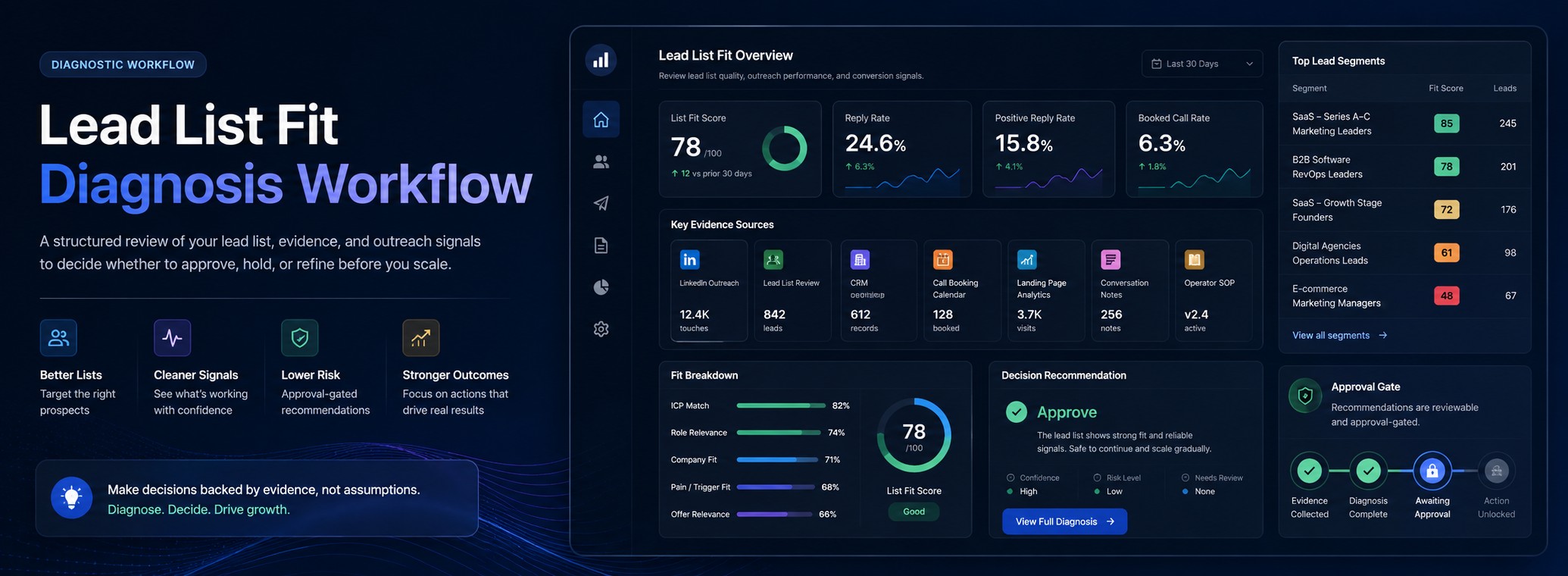
Lead List Fit Diagnosis Workflow
A lead list can make or break an outbound campaign before the first message is sent. If the list is weak, even strong copy, a clear offer, and consistent follow-up may produce poor results. If the list is strong, the team can interpret acceptance rates, replies, booked calls, objections, and conversion signals with more confidence.
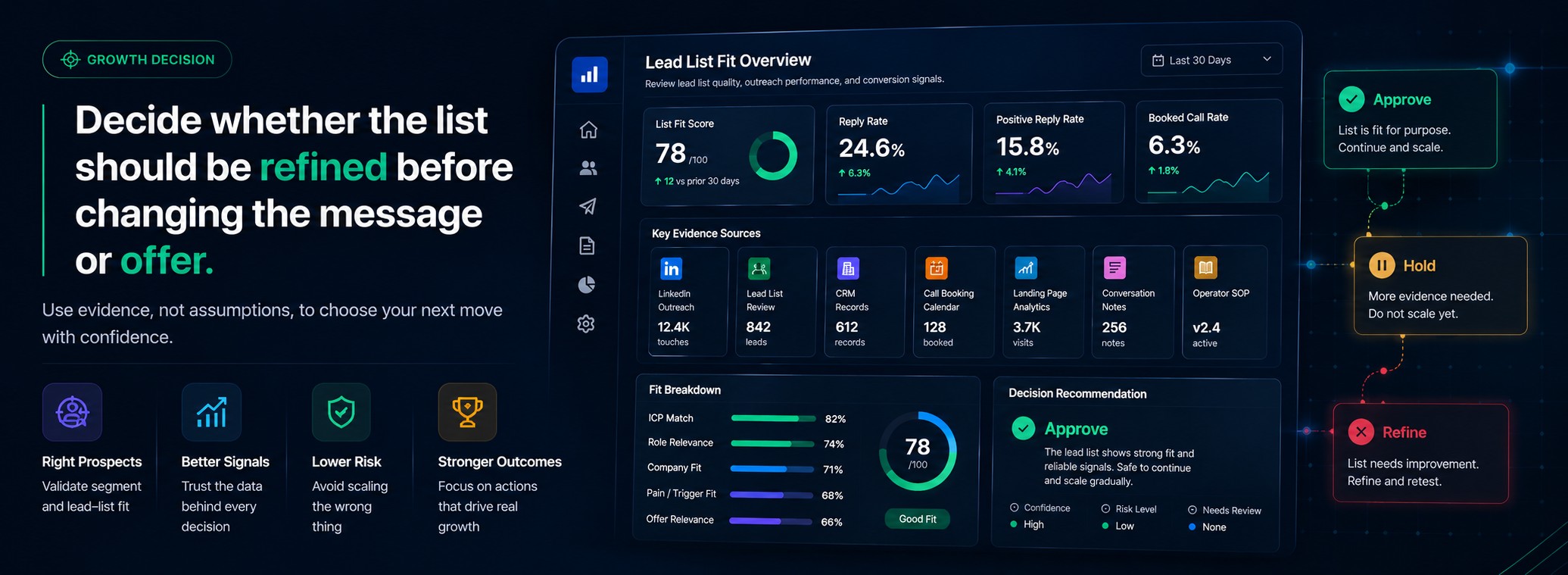
The Lead List Fit Diagnosis Workflow helps a founder, growth lead, or sales operator decide whether the list should be refined before changing the message, offer, automation, or outreach volume. Instead of treating weak LinkedIn DM results as a copywriting problem by default, this workflow checks whether the right prospects were selected in the first place.
The core decision is simple: approve the current list, hold the campaign, or send the list back for refinement before the next marketing action.
When To Use This Workflow
Use this workflow when outreach performance is unclear and the team is tempted to change the message, increase volume, hand the process to another operator, or add automation. It is especially useful when LinkedIn outreach data, CRM notes, call-booking calendars, landing page analytics, conversation notes, and the operator SOP tell an incomplete story.
The workflow helps separate list-quality problems from message-quality problems, offer-positioning problems, tracking problems, and operating problems. That distinction matters because changing the wrong lever can make the campaign worse. A better message will not fix a list of prospects who do not feel the pain. More volume will not fix a broken offer handoff. Automation will not improve results if the process is unstable.
Core Inputs To Review
The reviewer should start with visible evidence, not opinion. Each input should answer a specific part of the fit question.
- LinkedIn outreach data: Shows connection acceptance, reply rate, response timing, and engagement quality.
- Lead-list review: Confirms whether prospects match the intended segment, role, company type, and buying trigger.
- CRM records: Shows whether leads were qualified, updated, and moved through the right stages.
- Call-booking calendar: Confirms whether conversations turned into actual meetings.
- Landing page analytics: Shows whether interested prospects clicked through or abandoned the next step.
- Conversation notes: Reveals confusion, objection patterns, interest level, and offer fit.
- Operator SOP: Confirms whether the outreach process was followed consistently.
Step 1: Confirm The Target Segment
Before judging performance, the team should confirm who the campaign was meant to reach. A lead list should not only contain plausible buyers. It should contain prospects who match the specific decision profile the campaign was built for.
For example, if the offer is designed for B2B SaaS founders with active outbound sales motions, the list should not be filled with agencies, ecommerce stores, consultants, or companies without visible sales activity. Those may be real businesses, but they may not be the right audience for this campaign.
- Is the industry specific enough?
- Does the company size match the offer?
- Is the contact likely to own the problem?
- Is there a visible buying trigger or operational pain?
- Are excluded segments clearly removed from the list?
If these signals are missing, the next recommendation should be list refinement, not a message rewrite.
Step 2: Separate List Fit From Message Fit
A poor response rate does not automatically mean the message is bad. It may mean the message was sent to the wrong people. The workflow should separate these issues before recommending a next action.
If prospects match the target segment but do not respond, the message style, offer angle, or first-message posture may need testing. If prospects do not match the target segment, the message data is less reliable. The team cannot judge message quality from an audience that was unlikely to care.
- List-fit issue: Prospects do not match the target segment or buying trigger.
- Message-fit issue: Prospects match the segment, but the message does not create enough reason to reply.
- Offer-handoff issue: Prospects show interest but do not understand the next step.
- Tracking issue: The data cannot show which lever is actually failing.
Step 3: Review Response Quality
Not all replies are useful. A campaign may receive responses that do not indicate real buying interest. The reviewer should look at the quality of conversations, not only the number of replies.
Strong response quality may include relevant decision makers, clear pain recognition, requests for more information, booked calls, or objections that can be handled. Weak response quality may include confusion, irrelevant replies, vendor pitches, unqualified contacts, or prospects who clearly do not match the offer.
If the wrong people are responding, refine the list. If the right people are responding but not moving forward, the issue may be proof, CTA clarity, follow-up, or the offer handoff.
Step 4: Check The Offer Handoff
A lead list diagnosis should not stop at the first message. The team should also check whether interested prospects have a clear path from conversation to next step. Sometimes the list is strong and the message creates interest, but the campaign fails because the handoff is unclear.
- Does the prospect understand what happens after replying?
- Is the call or offer framed around a useful outcome?
- Is the landing page aligned with the outreach promise?
- Are proof, relevance, and next-step clarity strong enough?
- Is follow-up happening consistently after interest is shown?
If the offer handoff is unclear, the team should fix the handoff before changing prospecting volume.
Step 5: Review Tracking And Operating Quality
The team should only make confident decisions when tracking is clean enough to isolate the constraint. If outreach volume, acceptance rates, replies, booked calls, landing page visits, and CRM updates are disconnected, the recommendation should stay caveated.
Poor tracking can make the wrong lever look broken. A team may think the list is weak when the real issue is no follow-up. Or they may think the offer is weak when booked-call data was not updated correctly. The workflow should also separate a funnel leak from an operating leak, such as no owner, weak delivery, missing promotion, or unstable execution.
Approve, Hold, Or Refine
After reviewing the evidence, the workflow should produce a clear decision.
- Approve: The list is specific enough, the process is stable, and outreach can continue or scale carefully.
- Hold: The evidence is incomplete, contradictory, or not strong enough to support a confident next step.
- Refine: The list does not match the target segment closely enough, so targeting should improve before message or offer changes.
- Test: The list is usable, but message posture, offer handoff, or tracking needs a controlled test before scaling.
The recommendation should always include the caveat. If an important input is missing or contradicted, the output should be a review note, not an execution instruction. OpenAnalyst can summarize evidence and suggest the next action, but the recommendation should remain approval-gated until a reviewer accepts it.
Final Decision Rule
The best use of this workflow is to prevent the team from changing the wrong lever. If the list is the constraint, refine the list. If the message is the constraint, test the message. If the offer handoff is unclear, clarify the next step. If tracking is weak, improve measurement before making a scale decision.
A strong Lead List Fit Diagnosis Workflow keeps outbound decisions tied to evidence. It protects the campaign from premature scaling, weak assumptions, and generic recommendations while helping the reviewer decide whether the next growth action is ready, caveated, or still on hold.