Why a content production decision memo matters
A content production workflow should not move from idea generation to publishing based only on output speed or draft completion. The useful output is a decision memo that explains whether the content should move forward, stay on hold, return for revision, or remain blocked until stronger evidence or workflow approval is available.
This matters because production workflows are easy to misread. A large amount of content output may look productive even when the source context is weak, the audience fit is unclear, the packaging is generic, or the AI drafting workflow has not been reviewed properly. A repurposed asset may appear ready because the original source was useful, even though the adapted version removed the context that made the original valuable.
The memo exists to prevent false-ready publishing decisions. It gives the content lead a clear operational answer before increasing publishing volume, approving repurposed assets, assigning additional workflow owners, or scaling AI-assisted production.
The decision this memo should answer
The core decision is simple:
Should the team approve the next content production action, hold it until stronger evidence is available, or send it back for revision?
The memo should not only describe workflow activity. It should connect the evidence to a practical publishing or production decision. The team needs to know whether to produce more content, improve source quality, revise packaging, strengthen editorial review, change workflow ownership, or pause output until the evidence becomes stronger.
A strong memo should answer four operational questions:
- What decision is the content marketer or production lead trying to make?
- Which workflow input would make the reviewer trust the production recommendation?
- What caveat should remain visible before publishing or repurposing moves forward?
- Who owns the next action if the review is approved?
What evidence should be reviewed
The memo should combine workflow evidence with publishing context. Production speed alone does not prove content quality or audience usefulness. Source notes, AI drafting workflows, reviewer feedback, publishing checklists, and editorial approvals help explain whether the content is operationally ready.
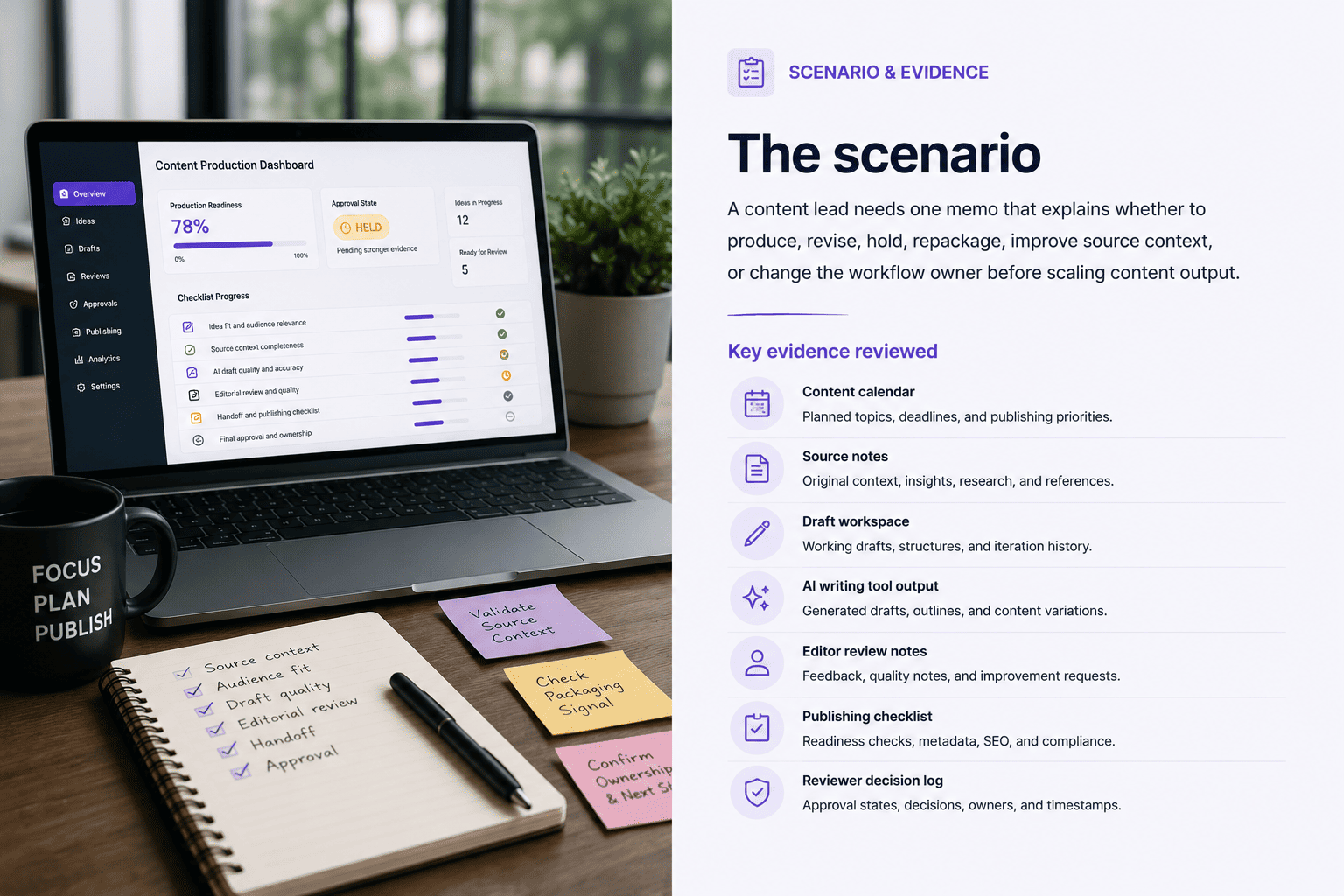
Content calendar
The content calendar helps explain what publishing action is being proposed. The reviewer should check whether the planned output supports a clear audience objective instead of only increasing production volume.
Source notes
Source notes are important because they preserve the original context, insight, evidence, or decision the content is supposed to communicate. Weak source material often leads to generic publishing output even when the writing quality appears acceptable.
Draft workspace
The draft workspace helps the reviewer understand how the content evolved during production. It can reveal whether the workflow preserved the original insight or drifted into filler content during revision.
AI writing tool output
AI-generated drafts should be reviewed carefully before approval. Fast drafting does not guarantee useful publishing output. The reviewer should check whether the workflow separates drafting speed from editorial acceptance and whether the AI output preserved the intended audience value.
Editor review notes
Editor review notes help clarify whether the content is structurally useful, properly packaged, and operationally aligned with the intended publishing goal. The reviewer should confirm whether unresolved concerns still affect the recommendation.
Publishing checklist
The publishing checklist helps validate whether required workflow approvals, packaging standards, ownership assignments, and publishing conditions are complete before the content moves forward.
Reviewer decision log
The reviewer decision log preserves approval history, hold states, workflow changes, and recommendation ownership. This keeps the production workflow reviewable and prevents unsupported decisions from appearing operationally approved.
How to write the finding
The finding should explain what changed and what the reviewer believes the workflow evidence means. The finding should be specific enough to support a publishing decision while remaining careful enough to avoid overclaiming.
A weak finding sounds like this:
The team produced more content, so publishing volume should increase.
A stronger finding sounds like this:
Recent production output increased, but the evidence does not yet prove that workflow quality, source context, and audience packaging are strong enough to justify scaling publishing volume.
The stronger version separates visible workflow movement from uncertain operational quality. It also tells the team what should be reviewed before the recommendation is approved.
How to write the caveat
The caveat protects the team from treating workflow activity as stronger evidence than it actually is.
For a content production decision memo, the caveat should usually focus on one of these operational risks:
The source material may not contain enough useful context to support reliable publishing output.
The repurposed asset may have removed the insight, proof, or audience relevance from the original source.
The content package may not clearly communicate who the content is for or why the audience should care.
The AI-assisted workflow may have accelerated drafting speed without preserving editorial quality.
The caveat should remain visible near the recommendation because it directly affects whether the publishing or production action should move forward.
How to write the recommendation
The recommendation should explain what changes, what remains on hold, and what evidence would make the production decision stronger.
For example:
Hold the publishing increase. Before scaling production volume, review whether the source context is strong enough to support audience-focused content and confirm that the next drafts preserve the original insight rather than generic workflow filler.
This recommendation is useful because it does not only say “hold.” It explains what must be reviewed before approval and gives the production lead a practical next step.
Approval states
The memo should end with a clear approval state. The most useful approval states are:
Approved
Use this when the evidence is strong enough to move forward. The memo should still identify the workflow owner, next action, and any required monitoring step.
Held
Use this when the publishing or production action may still become valid, but the evidence is not operationally strong enough yet. The reviewer should explain what information is missing.
Sent back for evidence
Use this when the recommendation is not production-ready. The reviewer should identify what workflow issue, packaging concern, or source-context gap must be revised before approval.
Common failure modes
One common failure mode is treating production activity as proof of publishing readiness. A workflow can generate large amounts of output while still lacking audience clarity, source quality, or editorial usefulness.
Another failure mode is skipping the source-context caveat. When this happens, the publishing recommendation can appear safer than the evidence allows.
A third failure mode occurs when AI-assisted drafting speed is treated as operational quality. Fast content generation should not replace editorial review, workflow ownership, or approval controls.
Another operational risk appears when repurposed assets remove the original insight that made the source material useful. The workflow should preserve audience value instead of converting useful material into generic filler content.
Checks before approval
Before the memo is approved, the reviewer should confirm whether the workflow separates observed evidence from the proposed publishing or production action.
The reviewer should also check whether the source material contains enough context to support useful publishing output.
If the workflow uses AI-assisted drafting, the reviewer should confirm that editorial approval remains separate from drafting speed.
The reviewer should also validate whether the content package clearly communicates audience relevance, publishing value, and topic usefulness.
If the workflow includes repurposed assets, the reviewer should confirm that the adapted version preserves the original context while fitting the publishing environment where it will be used.
Finally, the reviewer should check whether workflow ownership, publishing approval, and next-action responsibility remain clearly assigned before scaling content output.
Example decision memo structure
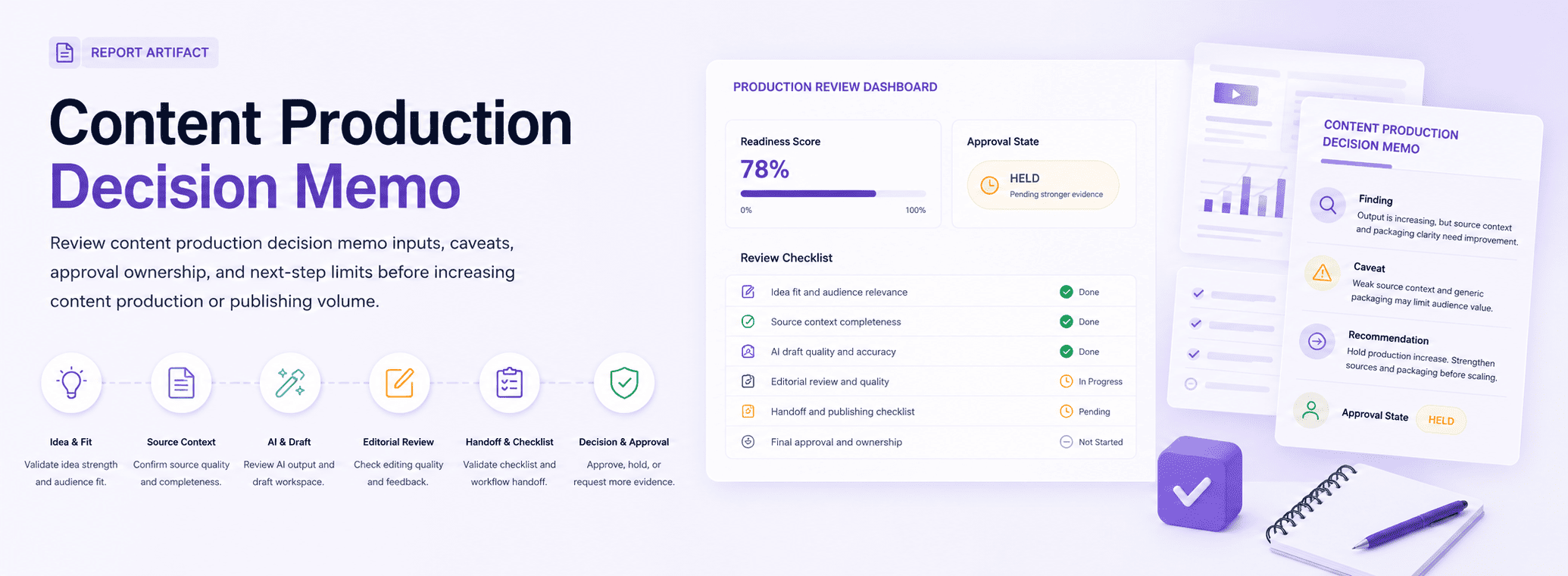
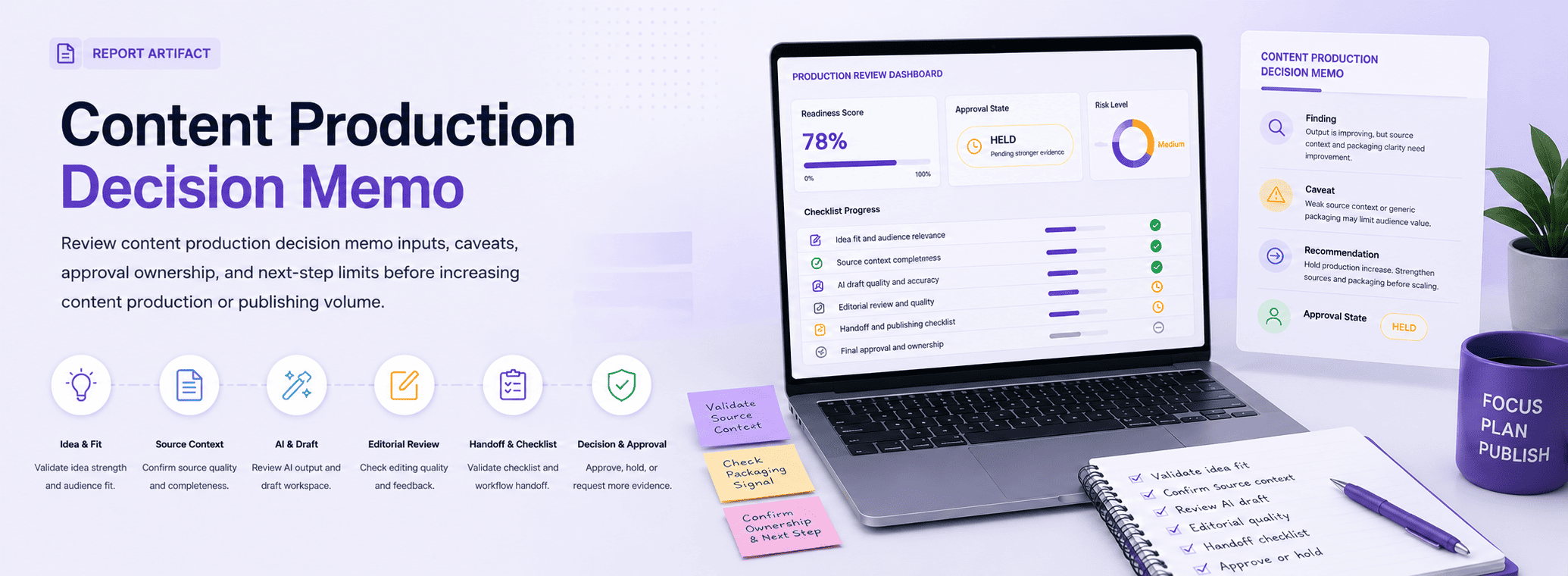
Finding
Recent production output increased, but the evidence does not yet confirm that source quality, packaging clarity, and editorial review standards are strong enough to justify scaling publishing volume.
Caveat
The current workflow may still rely too heavily on weak source context and AI-assisted drafting speed. The team should avoid increasing production volume until the next content batch preserves stronger audience value and editorial clarity.
Recommendation
Hold the publishing increase. Review the source context, revise the next content packages, and confirm that repurposed assets preserve the original insight before scheduling additional production.
Approval state
Held pending evidence. The content lead owns the next workflow review, while additional publishing volume remains on hold.
Final field note
OpenAnalyst should review the Content Production Decision Memo, compare the workflow evidence with the caveats, and keep the next recommendation approval-gated until the reviewer accepts it.