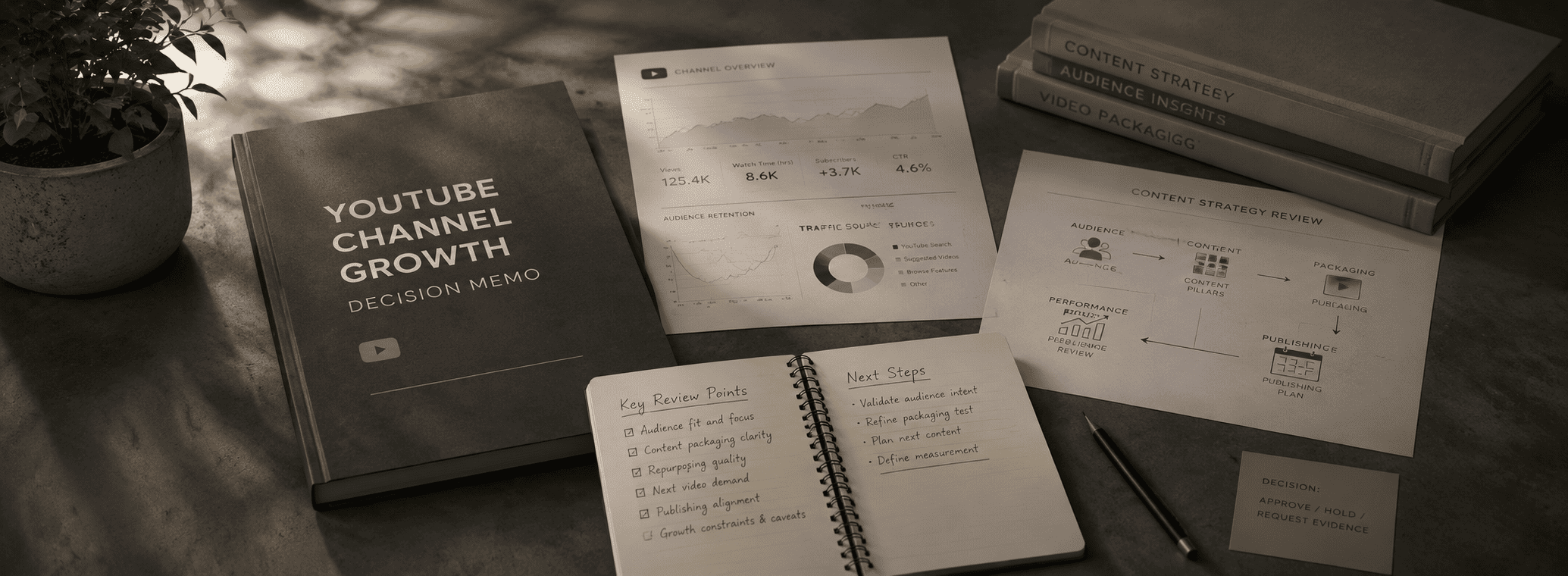
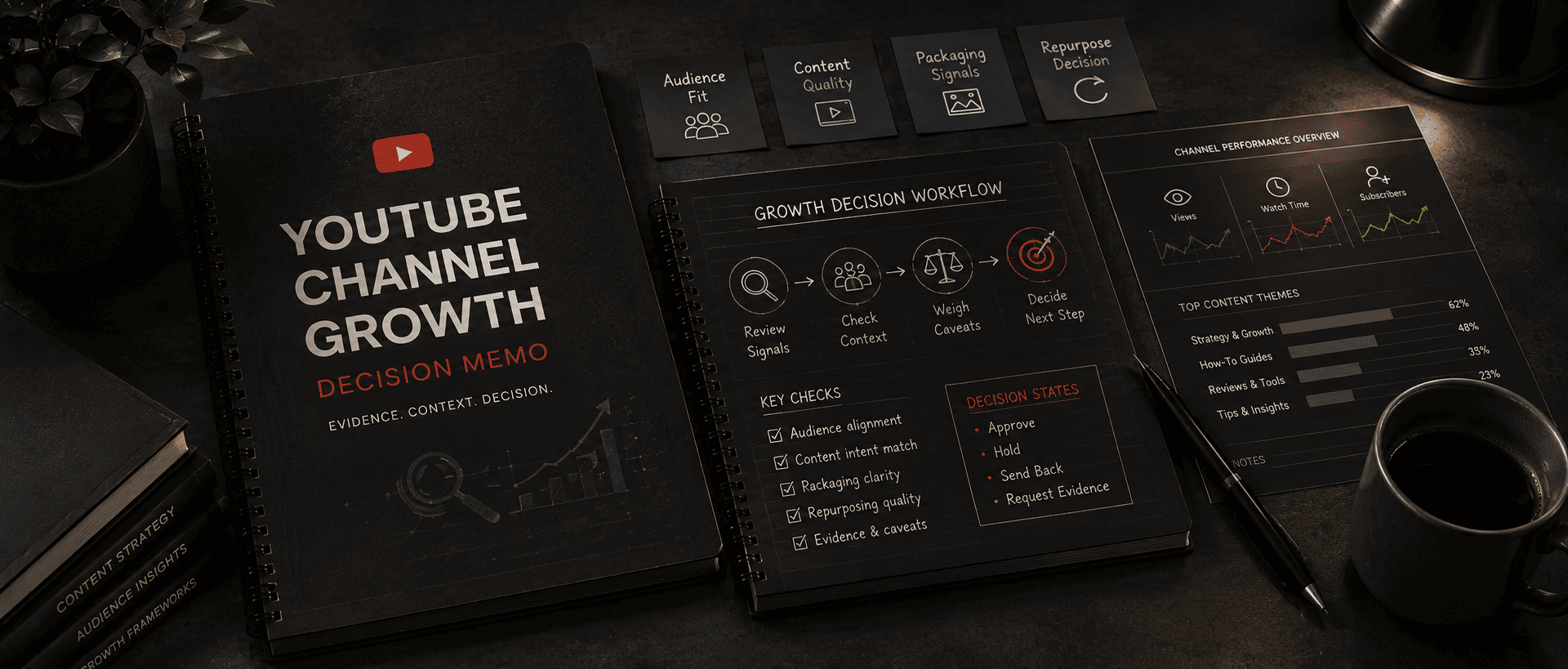
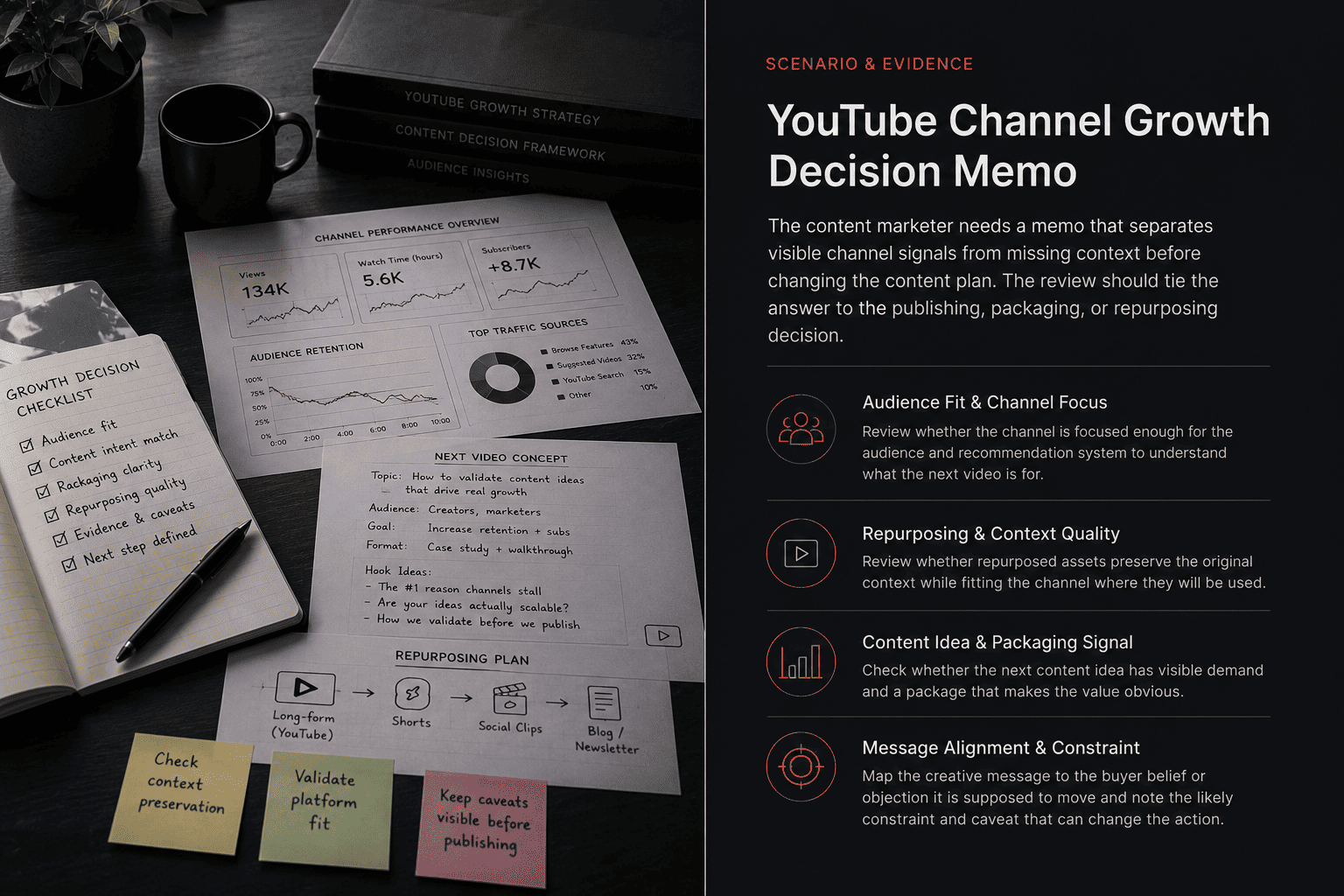
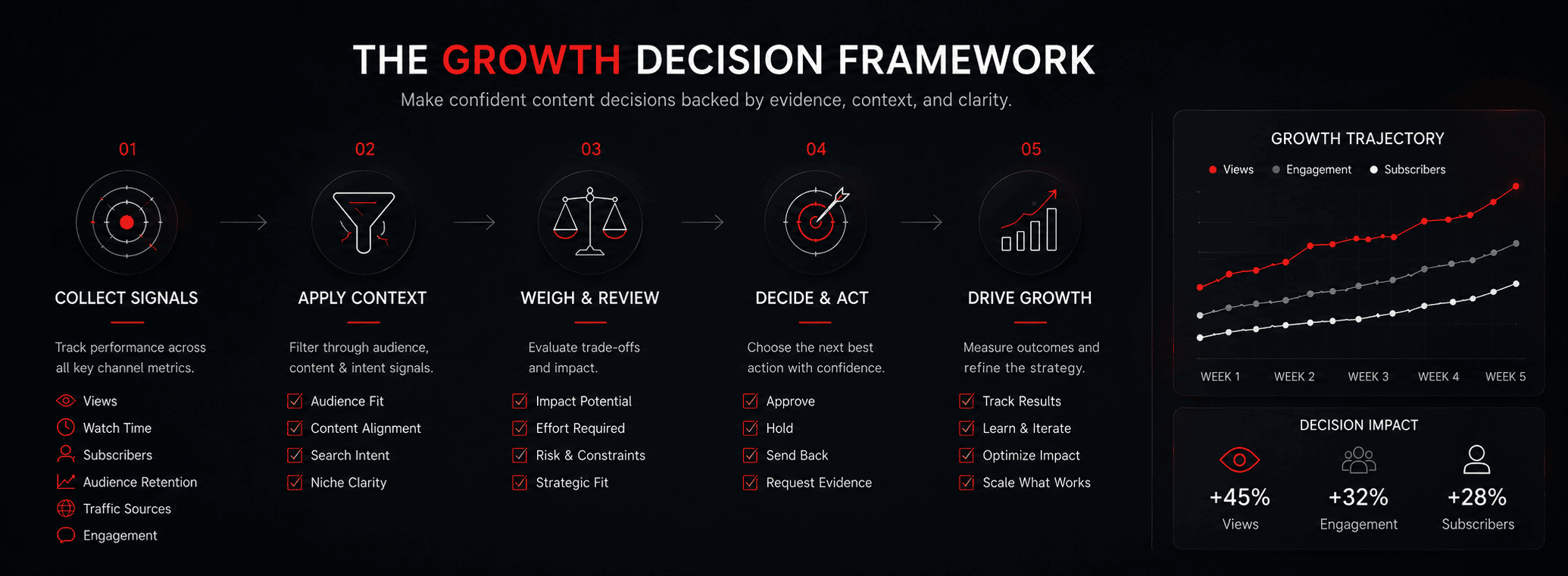
YouTube Channel Growth Decision Workflow
The YouTube channel growth decision memo exists to prevent content teams from changing publishing direction based on incomplete interpretation of channel performance signals. In enterprise publishing systems, growth recommendations cannot rely on isolated engagement spikes, temporary reach changes, or assumptions about audience intent without operational review.
The memo acts as a governance-controlled review layer between the analytics reviewer, the content strategist, and the publishing workflow owner. Its purpose is to determine whether the observed channel signals are reliable enough to justify a new content direction, packaging adjustment, publishing sequence, or repurposing decision.
Why Growth Signals Require Operational Review
Visible YouTube activity alone does not explain why a channel is growing, slowing, or becoming unstable. A reviewable recommendation requires evidence that connects audience response, recommendation-system behavior, publishing consistency, and content positioning into a defensible operational conclusion.
The reviewer should evaluate whether:
- The channel positioning is clear enough for audience expectations to remain stable.
- The recommendation system can consistently identify the content category and intended viewer segment.
- Publishing decisions are reinforcing a recognizable content direction instead of fragmenting audience intent.
- Performance changes are supported by repeatable behavior rather than temporary spikes.
- The proposed recommendation preserves the context behind the original engagement pattern.
Without this qualification process, teams often mistake visibility volatility for strategic direction, causing publishing systems to overreact before the underlying audience behavior is properly understood.
Channel Fit and Audience Alignment Controls
One of the most common causes of unstable channel growth is audience-positioning drift. This occurs when videos target inconsistent viewer expectations, mix unrelated content lanes, or introduce packaging that attracts low-intent visibility instead of qualified audience engagement.
The reviewer should hold the recommendation when:
- Video topics attract unrelated audience groups with conflicting viewing behavior.
- The channel niche becomes too broad for the recommendation system to classify consistently.
- Audience retention changes significantly between similar publishing formats.
- Content packaging suggests a value proposition different from the actual video outcome.
- The proposed growth action depends on assumptions that were not validated during review.
This governance layer prevents the organization from scaling a publishing strategy that lacks stable audience understanding.
Packaging and Publishing Decision Governance
Packaging decisions should remain operationally connected to audience intent. Titles, thumbnails, opening hooks, and publishing cadence influence whether viewers interpret the content as relevant, trustworthy, and worth continuing.
The review process should validate:
- Whether the thumbnail and title clearly communicate the intended viewer outcome.
- Whether the publishing sequence reinforces the channel’s positioning rather than weakening it.
- Whether content packaging creates misleading expectations that damage retention quality.
- Whether the next planned video logically extends the audience journey from previous uploads.
- Whether publishing cadence changes are supported by operational evidence instead of pressure to increase output.
A packaging adjustment should not move into execution until the reviewer confirms that the recommendation remains aligned with both audience expectations and long-term channel positioning.
Repurposing and Distribution Review
Repurposed YouTube assets require separate operational review because successful long-form content does not automatically translate into reliable short-form or cross-platform performance. The reviewer must evaluate whether the original context survives adaptation into a different publishing environment.
The recommendation should remain approval-gated when:
- The short-form adaptation removes the strategic insight that created the original engagement.
- The edited asset changes the audience expectation established by the source video.
- The target platform favors different viewer behavior than the originating channel.
- The workflow cannot explain why the repurposed version should perform reliably in the new environment.
- The proposed distribution sequence introduces audience-fit risk that has not been validated.
This review structure ensures that content expansion decisions remain evidence-linked instead of reaction-driven.
Approval States and Operational Accountability
Every recommendation inside the memo should include a visible approval state that clarifies what action is allowed, what remains blocked, and which reviewer owns the next operational decision.
The memo should explicitly define:
- What finding is considered operationally reliable.
- What caveat must remain attached to the recommendation.
- What publishing or packaging adjustment is approved immediately.
- What action remains blocked until additional evidence is reviewed.
- Who owns the next review or implementation step.
This prevents downstream teams from interpreting conditional observations as finalized growth strategy.
Why the Decision Memo Matters
The YouTube channel growth decision memo is not a reporting summary. It is a governance-controlled decision framework designed to separate visible growth signals from unsupported assumptions before the publishing workflow changes direction.
By preserving audience-fit caveats, evidence dependencies, packaging logic, and approval ownership inside a single operational review layer, the workflow allows marketing teams to scale only the recommendations that remain defensible after validation.