YouTube and Social Growth Review Workflow
The YouTube and social growth memo exists to prevent distribution decisions from moving forward on incomplete engagement interpretation. In this workflow, the reviewer is not validating whether content generated activity alone; the review determines whether the observed audience response is operationally reliable enough to justify publishing expansion, repurposing investment, or additional promotional sequencing.
The memo functions as a decision-controlled artifact between the analytics reviewer, the content marketer, and the publishing workflow owner. Every recommendation must remain traceable to reviewable evidence, visible caveats, and an approval state that clarifies whether the next action is authorized, delayed, or returned for additional validation.
Review Inputs Used Before Recommendation Approval
The reviewer begins by consolidating YouTube, LinkedIn, Instagram, CRM, and analytics evidence into a single operational review layer. The purpose is not to compare vanity metrics independently, but to determine whether engagement quality remains consistent across publishing environments and audience segments.
- Review whether YouTube retention patterns support the claimed audience interest.
- Check whether social engagement aligns with the intended audience segment rather than broad low-intent visibility.
- Compare content interaction against CRM-linked outcomes where available.
- Validate whether Google Analytics behavior supports the interpretation being proposed in the recommendation.
- Review whether spreadsheet summaries preserve the original context of the engagement evidence.
At this stage, the reviewer should avoid converting directional engagement into approved growth language. A growth finding becomes operationally usable only after evidence quality, attribution limits, and platform-fit caveats remain visible inside the memo.
Approval-Gated Recommendation Logic
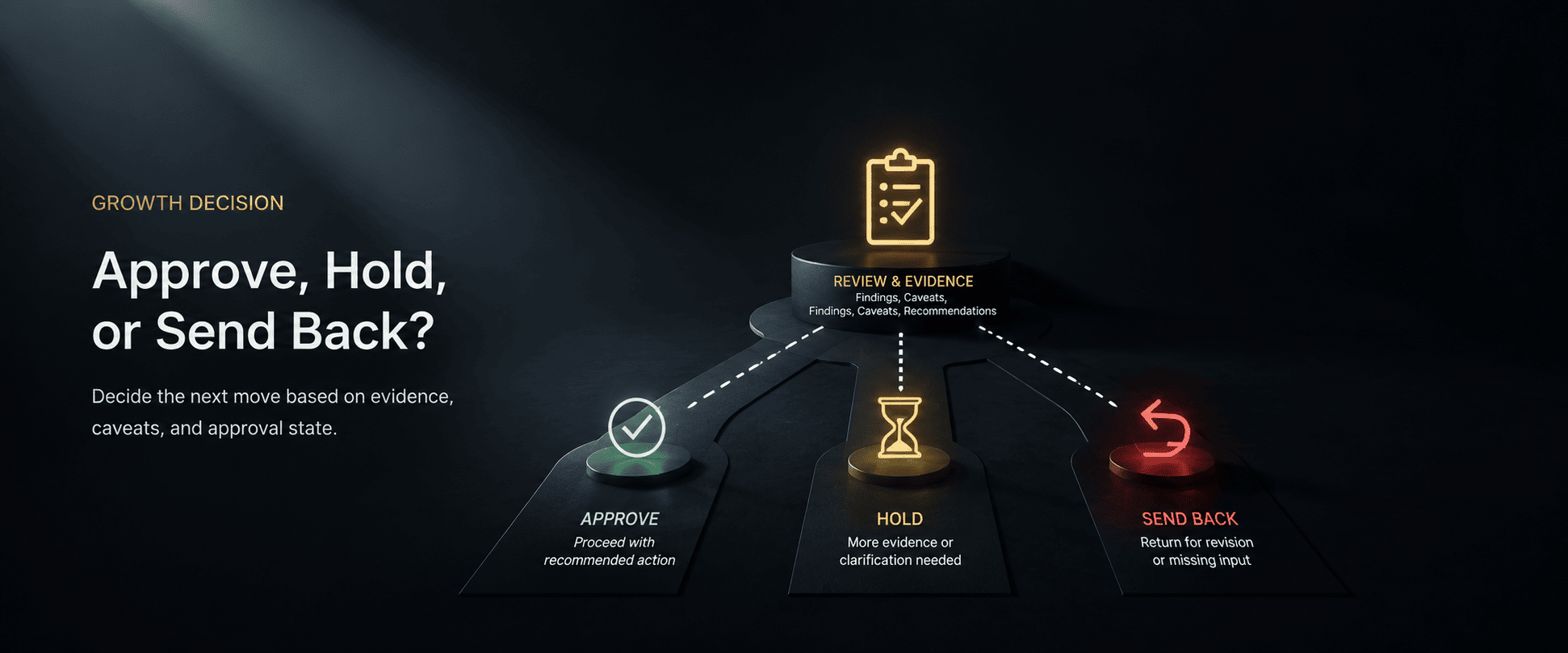
The recommendation layer inside the memo must remain approval-gated. The reviewer should explicitly define whether the evidence supports immediate action, restricted follow-up, additional observation, or review escalation before any publishing or repurposing adjustment is approved.
The approval state should answer four operational questions:
- What finding is reliable enough to operationalize?
- What caveat must remain attached to the recommendation?
- What follow-up action is approved immediately?
- What action stays blocked until additional validation is completed?
This structure prevents the content workflow from treating preliminary engagement patterns as settled performance conclusions. A recommendation without visible qualification increases the risk of over-scaling weak signals, misreading audience intent, or repurposing content into environments where the original context no longer applies.
Social Signal Qualification Controls
The memo review should distinguish between qualified audience response and isolated visibility spikes. Social activity becomes operationally meaningful only when engagement quality can be connected to audience fit, content intent, and a reviewable next-step recommendation.
The reviewer should hold the recommendation when:
- Engagement is high but retention quality remains unstable.
- Audience response varies significantly across channels without explanation.
- Repurposed assets remove the context that created the original engagement.
- Follow-up proposals depend on assumptions that were not validated during review.
- Publishing expansion is being recommended before attribution caveats are reviewed.
The purpose of this control is to stop operational teams from converting temporary visibility into long-term publishing direction before the underlying signal quality is understood.
Repurposing and Packaging Governance
Repurposing decisions require separate review because engagement success inside one platform does not guarantee transferability across another publishing environment. The reviewer should validate whether the original insight, audience expectation, and message framing remain intact after adaptation.
A repurposed asset should not be approved when:
- The short-form version removes the operational insight that supported the original recommendation.
- The adapted asset changes audience expectation without updating the qualification caveat.
- The publishing environment favors different engagement behavior than the source platform.
- The review cannot explain why the repurposed version should perform reliably in the new channel.
This governance layer ensures that packaging adjustments remain evidence-linked rather than reaction-driven.
Operational Failure Prevention
The most common workflow failure occurs when recommendations move into execution before caveats remain operationally visible. In enterprise publishing environments, missing qualification language often causes downstream teams to interpret conditional findings as approved strategy.
To prevent this, the memo should preserve:
- Visible approval status.
- Recommendation ownership.
- Blocked actions.
- Evidence dependencies.
- Audience-fit caveats.
- Review escalation conditions.
Every approved recommendation should remain review-traceable. If the publishing or growth decision cannot be tied back to validated evidence and reviewer acceptance, the action should remain in hold status until governance checks are completed.
Why the Memo Matters Operationally
The YouTube and social growth memo is not a reporting summary. It is a governance-controlled decision layer that protects publishing systems from overreacting to incomplete engagement interpretation. By keeping findings, caveats, approvals, and ownership states connected, the workflow allows marketing teams to scale only the recommendations that remain operationally defensible after review.