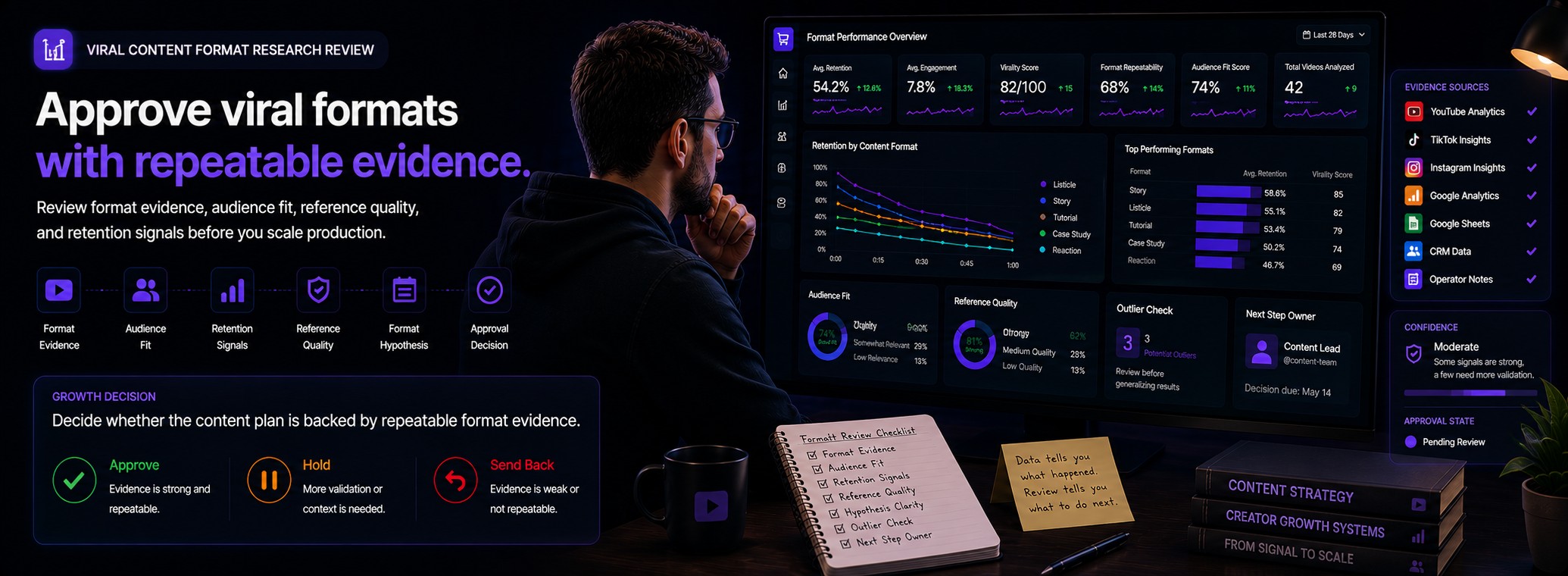
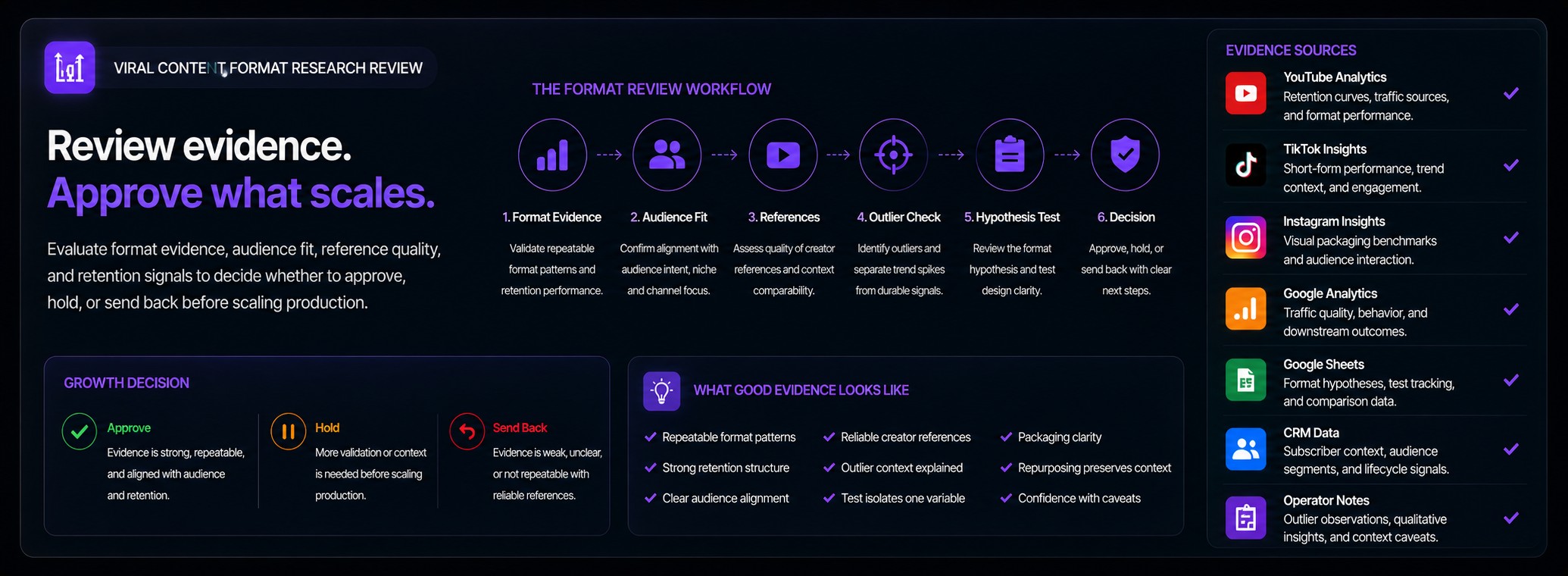
Viral Content Format Research For Growth Decisions
A viral content format research review evaluates whether a social content plan is grounded in repeatable format evidence, reference reliability, and a testable format hypothesis before production volume increases. The review separates format visibility from format durability so the team does not scale content investment based on isolated viral outcomes.
Most viral content strategies fail because teams mistake a single high-performing post for proof of a scalable format. Repeatable performance requires audience fit, retention structure, packaging clarity, platform-native formatting, and consistent topic-to-audience alignment. The review determines whether those conditions exist before the team commits additional production resources.
- Define the format hypothesis before reviewing performance evidence.
- Separate isolated viral outcomes from repeatable format structure.
- Confirm audience fit across platform-specific engagement signals.
- Validate reference account reliability and strategic comparability.
- Document the hold condition if the review is not approved.
A decision to scale social content should not be driven by a single viral post or a competitor trend. It should be driven by evidence that the format structure is repeatable, the audience alignment is durable, and the packaging can sustain engagement beyond the initial visibility spike.
Define The Exact Format Hypothesis Before Research Begins
The review begins by articulating the specific format hypothesis the content plan is testing. Format research should not evaluate general content performance. It should evaluate whether a defined structure produces predictable audience response across multiple instances and platforms.
Teams that skip format hypothesis definition frequently chase trending posts without understanding what structural element drove the performance. The resulting content plan becomes reactive rather than strategic, and the team cannot distinguish between format strength and coincidence.
- Define the format structure before researching reference examples.
- Identify the specific audience response the format is expected to produce.
- Document the hypothesis in Google Sheets for tracking and iteration.
- Separate format claims from trend-driven observations.
- Assign ownership for the format hypothesis under review.
A clearly defined format hypothesis creates a benchmark against which performance evidence can be measured. Without it, format research becomes a collection of viral observations disconnected from a testable content strategy.
Validate Repeatable Format Performance Across Multiple Instances
A single high-performing video does not prove that a format is scalable. True repeatability requires consistent audience response, stable retention behavior, and cross-platform performance alignment across multiple content instances and publishing periods.
The readiness review evaluates whether the format has performed consistently rather than once. If the format worked only under specific timing conditions, with a particular creator, or during a platform trend window, the repeatability claim should remain caveated.
- Confirm the format has produced results more than once.
- Evaluate whether performance is consistent across publishing periods.
- Review cross-platform format behavior for alignment.
- Identify whether timing or novelty explains the outlier result.
- Document repeatability gaps before approving production scale.
If repeatability is unclear, the recommendation should remain on hold. Expanding production on an unproven format amplifies risk rather than growth.
Review Audience-Fit Quality Against Channel Goals
A viral format only supports sustainable growth when it reaches the audience the channel is actually trying to build. Videos can generate high view counts while attracting viewers who do not align with subscriber goals, customer profiles, or long-term channel positioning.
The readiness review compares audience engagement signals against the intended target profile. If the format attracts the wrong audience, scaling production may increase short-term visibility while damaging recommendation consistency, subscriber quality, and downstream conversion behavior.
- Define the target audience profile for the format.
- Compare current viewer demographics against that profile.
- Evaluate whether engagement signals reflect the intended audience.
- Identify viewership that weakens channel positioning.
- Document audience-fit gaps before scaling format production.
Audience fit should be confirmed before the team invests more production volume into a format. Producing more content for the wrong audience accelerates misalignment rather than fixing it.
Evaluate Reference Account Reliability And Comparability
Not every successful creator or high-performing account should become a strategic reference for format research. Reference accounts that operate in different niches, target different audience behaviors, or benefit from advantages unavailable to the team produce unreliable comparisons.
The readiness review evaluates whether reference accounts share similar content economics, audience profiles, and operational conditions. Copying large creators without validating contextual comparability frequently creates unrealistic format expectations.
- Confirm reference accounts operate in a comparable niche.
- Evaluate whether the reference audience matches the target profile.
- Identify whether celebrity leverage or brand recognition explains performance.
- Review whether reference formats have been used consistently over time.
- Document reference caveats when comparability is limited.
If the reference format depends on distribution advantages, paid promotion, or brand recognition unavailable to the team, the recommendation should remain caveated and the format hypothesis should be tested independently before production scales.
Separate Trend-Driven Performance From Durable Format Strength
Trend spikes create misleading evidence of format strength. Algorithmic amplification, topic novelty, and platform trend participation can drive temporary visibility that disappears once the trend cycle ends. Formats built entirely around trend participation often collapse when novelty fades.
The readiness review distinguishes between temporary trend visibility and durable audience demand. A format that performs only during trend windows may not represent a repeatable content strategy.
- Identify whether performance coincides with platform trend cycles.
- Evaluate whether audience demand exists independent of novelty.
- Separate algorithmic amplification from organic format strength.
- Review whether the format has performed outside trend windows.
- Document trend-related caveats before treating results as reusable proof.
Formats with durable demand continue performing after trend visibility declines. When performance depends heavily on temporary timing, the review should avoid treating the result as evidence of a scalable format.
Inspect Retention Structure For Engagement Depth
Strong retention signals meaningful format structure. A video that loses viewers immediately after the opening hook may rely on curiosity clicks rather than delivering sustained value. High view counts with poor retention typically indicate packaging strength without content depth.
The readiness review inspects opening-hook effectiveness, pacing quality, segment transitions, information density, visual rhythm, and narrative progression. Each structural element should support sustained attention rather than depending on the first second of the video alone.
- Review opening-hook drop-off patterns.
- Evaluate pacing quality and information density.
- Inspect segment transitions for engagement continuity.
- Assess whether visual rhythm maintains viewer attention.
- Document retention gaps before approving format expansion.
Strong packaging attracts initial views. Strong retention structure confirms that the format delivers on the packaging promise. When retention drops sharply after the opening, the format should be refined before production scales.
Keep Format Research Caveats Visible During The Review
Decision-makers should see evidence limitations alongside format findings. Caveats around reference reliability, audience mismatch, trend dependency, retention weakness, and packaging uncertainty should remain attached to the recommendation throughout the review process.
Burying caveats in supporting documentation creates a false impression of format readiness that leads to premature production scaling. Every finding should carry its limitation so the reviewer can weigh confidence alongside evidence.
- Document which format signals are incomplete or unverified.
- Surface audience-fit assumptions and their limitations.
- Highlight reference account caveats that affect comparability.
- Make trend-dependency risks explicit.
- Separate confidence from certainty in every format finding.
Visible caveats improve trust by helping stakeholders understand both the strengths and limitations of the format evidence. The review should not approve more production when significant caveats remain unresolved.
Approval-Gated Format Reviews Protect Content Strategy Quality
Social content decisions move quickly, but speed can hide weak format evidence. An approval-gated review ensures the team does not confuse a single viral outcome with proof of a repeatable content strategy when deciding whether to increase format production volume.
The reviewer should approve only the next step supported by visible format evidence. If repeatable performance, audience alignment, retention structure, or reference quality evidence is not visible, the output should be a hold note rather than a production approval.
- Assign an owner for the next content format decision.
- Document reviewer acceptance of the format evidence.
- Track approval state before production volume changes.
- Identify unresolved format dependencies that could block success.
- Keep follow-up actions visible until format evidence improves.
Approval gating protects teams from acting on format visibility when the underlying format evidence remains incomplete. The review should answer a clear decision: approve, hold, or send back for more evidence before content production scales.