Why YouTube channel growth reviews matter
YouTube growth is often treated as a publishing problem. Teams assume the solution is to upload more frequently, increase production volume, or expand into more topics. But many channels fail to grow because the real constraint is not output volume. The real issue is often niche clarity, packaging quality, watch-time retention, repurposing fit, or measurement confidence.
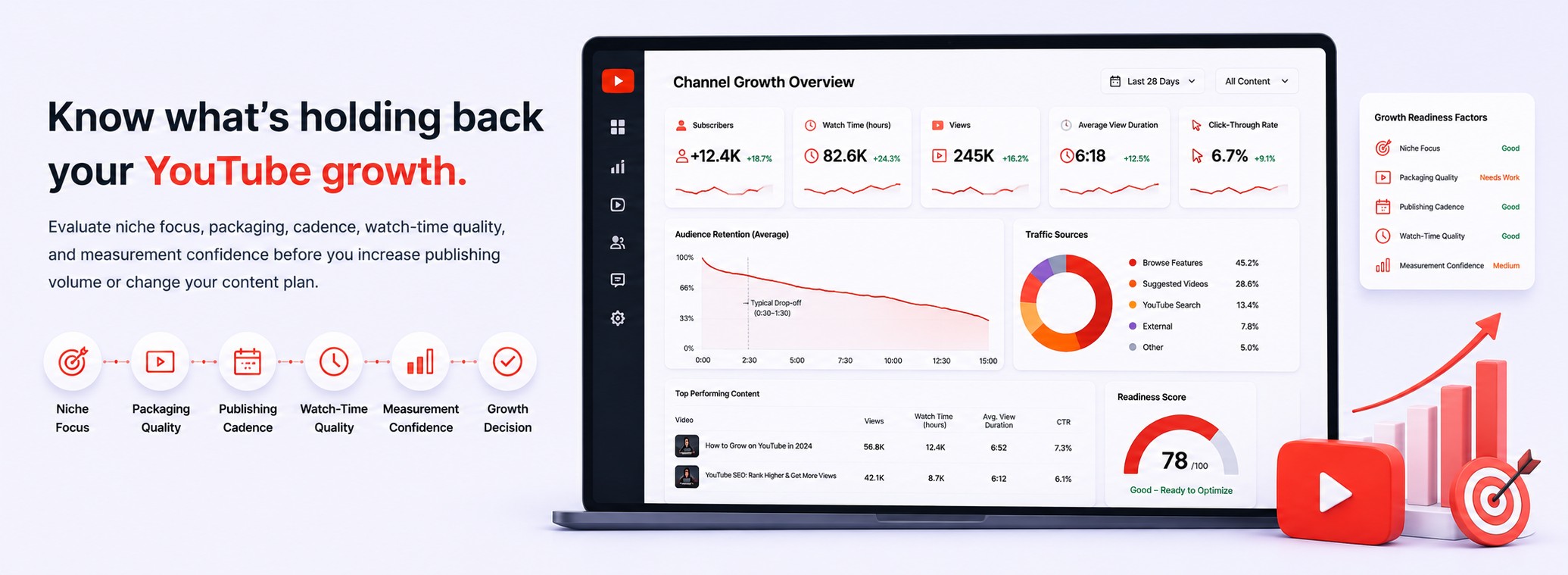
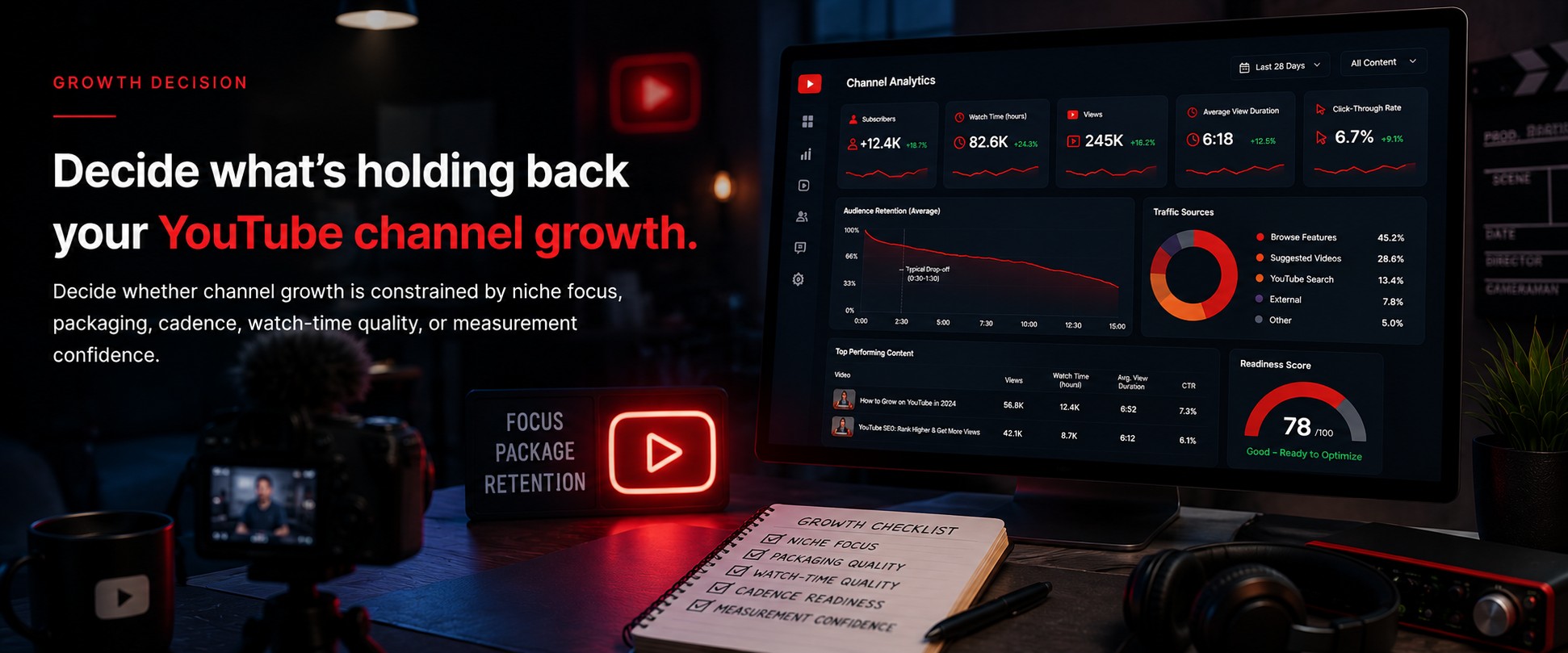
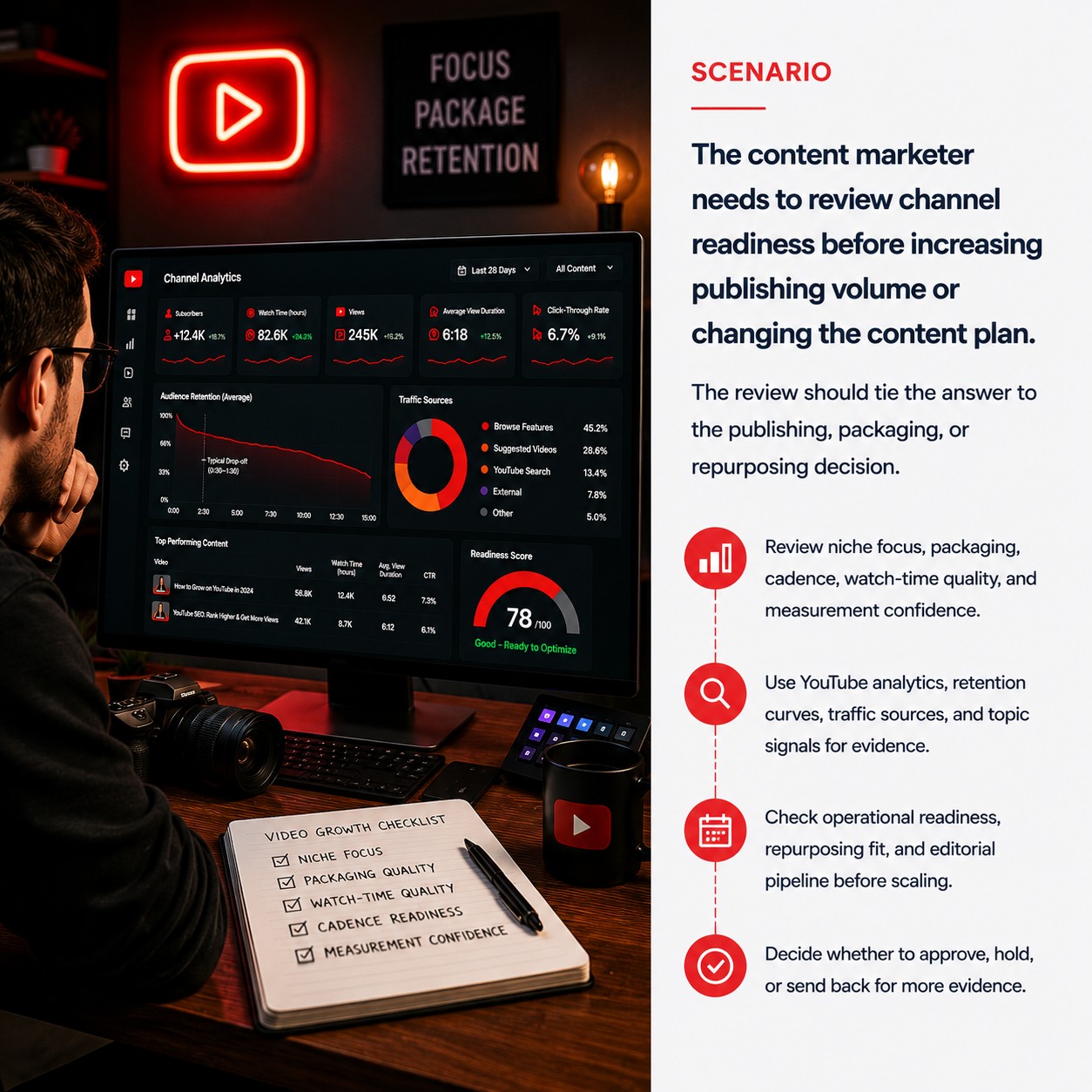
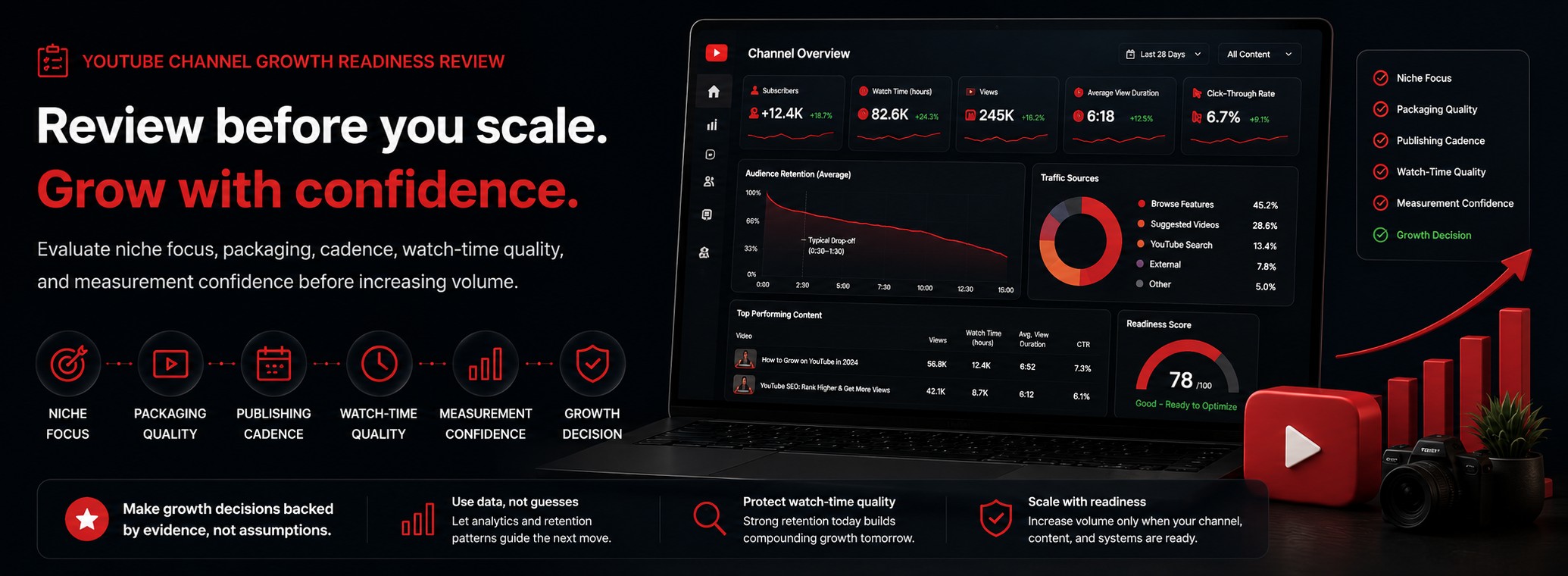
The YouTube Channel Growth Readiness Review helps a content marketer or growth team decide whether channel growth is constrained by niche focus, packaging, cadence, watch-time quality, or measurement confidence before increasing publishing volume or changing the content strategy.
This workflow is designed to produce a reviewable growth decision instead of generic creator advice. The output should explain what changes, what stays held, what evidence supports the recommendation, and what caveat still needs to remain visible.
What this workflow helps decide
The review helps answer whether the next action should:
- Increase publishing cadence
- Narrow the niche focus
- Improve video packaging
- Change content formats
- Repurpose existing assets differently
- Improve retention quality
- Hold the growth plan until stronger evidence exists
The correct output is not simply “make more videos.” The reviewer should identify which part of the growth system is limiting performance before recommending more volume.
Inputs required for the review
- YouTube Analytics: Review audience retention curves, traffic source breakdowns, topic clustering, CTR, watch time, session contribution, subscriber conversion, and returning viewer behavior.
- Google Analytics: Validate search demand, referral traffic, landing behavior, and content trend signals.
- Google Sheets: Review editorial calendar status, production pipeline readiness, publishing cadence history, and watch-time tracking.
- CRM: Compare audience segments, attribution patterns, and business alignment with content themes.
- Operator Notes: Add context around publishing decisions, workflow bottlenecks, production quality issues, and channel experiments.
Step 1: Review niche focus
The first review question is whether the channel is focused enough for the audience and recommendation system to understand what the next video is for.
Many channels struggle because the content lane is too broad. Videos may perform individually, but the channel lacks a clear audience expectation. When viewers cannot predict what value the next upload provides, retention and recommendation consistency weaken.
The reviewer should inspect:
- Topic clustering across recent uploads
- Subscriber overlap between video categories
- Returning viewer behavior
- Audience retention consistency
- Traffic source dependency
If the niche focus is unclear, the correct action may be to narrow the content lane before increasing cadence.
Step 2: Evaluate packaging quality
A strong content idea can still fail if the packaging does not clearly communicate value. Packaging includes the title, thumbnail, opening hook, topic framing, and positioning.
The reviewer should determine whether the package immediately answers:
- Who is this for?
- Why does this matter now?
- What problem does it solve?
- What insight or transformation will the viewer get?
Weak packaging often produces low click-through rates even when the underlying topic is valuable. A reviewer should avoid treating low CTR as proof that the topic itself is weak.
Step 3: Review watch-time quality
Watch-time quality matters more than raw impressions. A channel may attract clicks but still fail to grow if retention drops early or viewers do not continue into additional sessions.
The reviewer should inspect:
- First 30-second retention drops
- Audience retention curves
- Session watch behavior
- End-screen continuation rates
- Subscriber conversion from videos
- Returning viewer percentage
If retention quality is weak, the issue may be pacing, structure, editing, unclear positioning, or mismatch between the thumbnail promise and the content delivery.
Step 4: Validate demand before scaling production
Publishing more content only works when there is evidence that the audience wants more of that content category. The reviewer should validate visible demand before approving higher publishing volume.
Demand validation may include:
- Search volume trends
- Suggested video behavior
- Topic momentum
- Audience comment patterns
- Community requests
- High-retention content themes
If demand is weak or inconsistent, the reviewer should hold the production increase and recommend additional topic testing instead.
Step 5: Review publishing cadence readiness
Some channels are not operationally ready for more publishing volume. Increasing cadence without a stable workflow often lowers quality, weakens packaging, and creates audience inconsistency.
The reviewer should inspect:
- Editorial calendar readiness
- Production bottlenecks
- Script pipeline status
- Thumbnail workflow consistency
- Editing turnaround time
- Review and approval process
If the system cannot maintain quality at higher output levels, the correct action may be workflow optimization rather than increased publishing.
Step 6: Evaluate repurposing quality
Repurposing should preserve the original insight while adapting it to the destination platform. Many teams turn useful long-form videos into generic social clips that lose the original decision value.
The reviewer should check whether repurposed assets:
- Keep the original insight intact
- Match platform expectations
- Maintain context clarity
- Deliver standalone value
- Support the channel’s positioning
If platform fit is weak, the asset should remain in draft mode until revised.
Step 7: Map the content to audience beliefs
Content performance is often tied to whether the message aligns with the viewer’s current beliefs, frustrations, or goals.
The reviewer should identify:
- Which buyer belief the content addresses
- Which misconception it challenges
- Which desired outcome it promises
- Which audience stage it targets
When content is disconnected from audience psychology, higher production volume rarely solves the growth problem.
Step 8: Separate evidence from assumptions
The reviewer should distinguish measured evidence from assumptions. Strong recommendations require visible support from analytics, retention data, audience behavior, or workflow readiness.
Assumptions may include:
- Predicted audience interest
- Estimated topic demand
- Assumed algorithm behavior
- Unverified audience overlap
If the recommendation depends heavily on assumptions, the output should remain a scenario rather than an approved growth action.
Failure modes this workflow prevents
This review helps prevent several common YouTube growth mistakes:
- Scaling publishing volume before fixing packaging problems
- Blaming the algorithm instead of niche inconsistency
- Treating impressions as proof of audience fit
- Repurposing content without preserving context
- Expanding into unrelated topics too early
- Overlooking operational bottlenecks
Recommended decision outcomes
- Approve: The channel has enough niche clarity, packaging quality, retention strength, and operational readiness to support the next growth action.
- Hold: The evidence is incomplete or the caveat is large enough to change the recommendation.
- Send back: The team should revise the topic strategy, packaging, cadence, or measurement setup before scaling.
What should remain approval-gated
OpenAnalyst can draft recommendations, review memos, content plans, repurposing suggestions, and packaging revisions. Execution should remain approval-gated.
The tool should not automatically change publishing cadence, schedule uploads, expand production, or alter the channel strategy until the reviewer accepts the evidence and caveats.
OpenAnalyst should review YouTube Channel Growth Readiness Review, compare the decision evidence with the caveats, and keep the next recommendation approval-gated until the reviewer accepts it.
Final review checklist
- Is the niche focus clear enough for the audience and recommendation system?
- Does the packaging make the value obvious?
- Is watch-time quality strong enough to support growth?
- Does the next content idea show visible demand?
- Is the publishing system operationally ready for more volume?
- Does repurposed content preserve context?
- Is the creative message aligned with audience beliefs?
- Are evidence and assumptions clearly separated?
- Does the recommendation clearly state what changes and what stays held?