YouTube Production Workflow Review
Use YouTube Production Workflow Review to separate visible evidence, caveats, and approval gates before the team changes growth work.
Decide whether production quality, constraints, and cadence support the content plan.
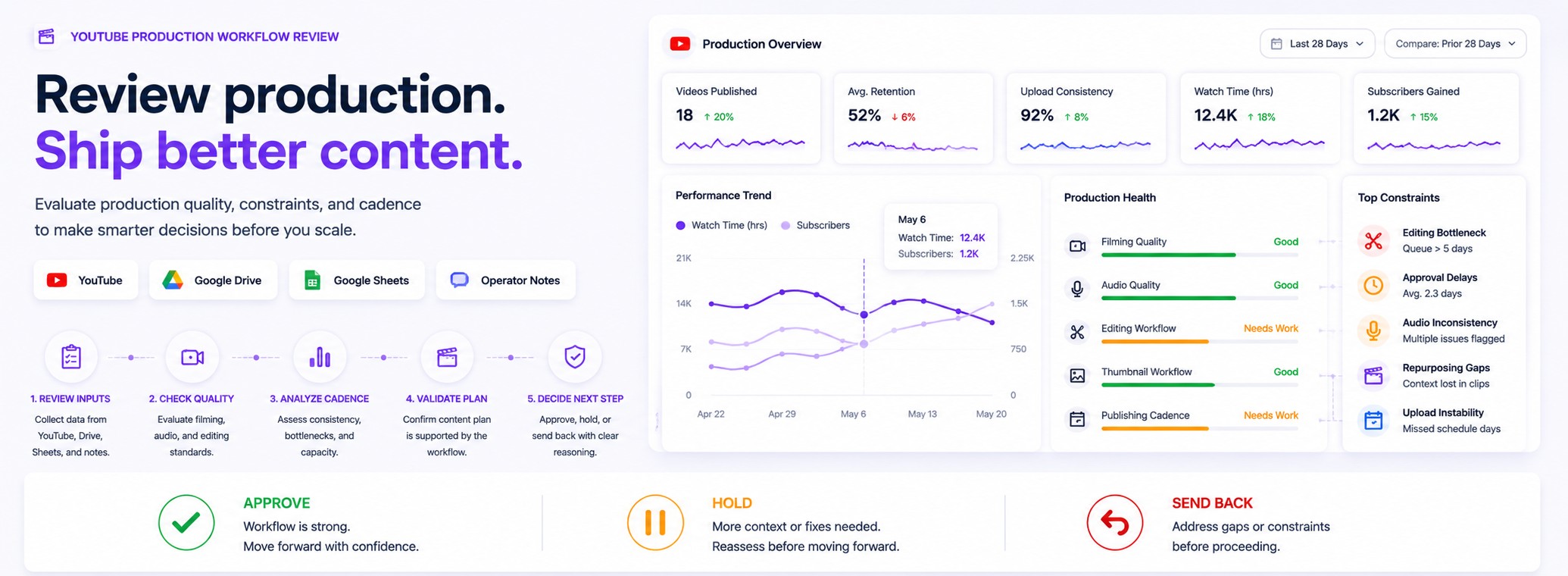
Three steps to a confident decision
Understand which business situation this page was built for and confirm it matches your current context.
Go item by item — each check has a clear pass/hold condition so you know exactly what qualifies.
Use the growth decision statement and analyst questions to brief your team and move forward with confidence.
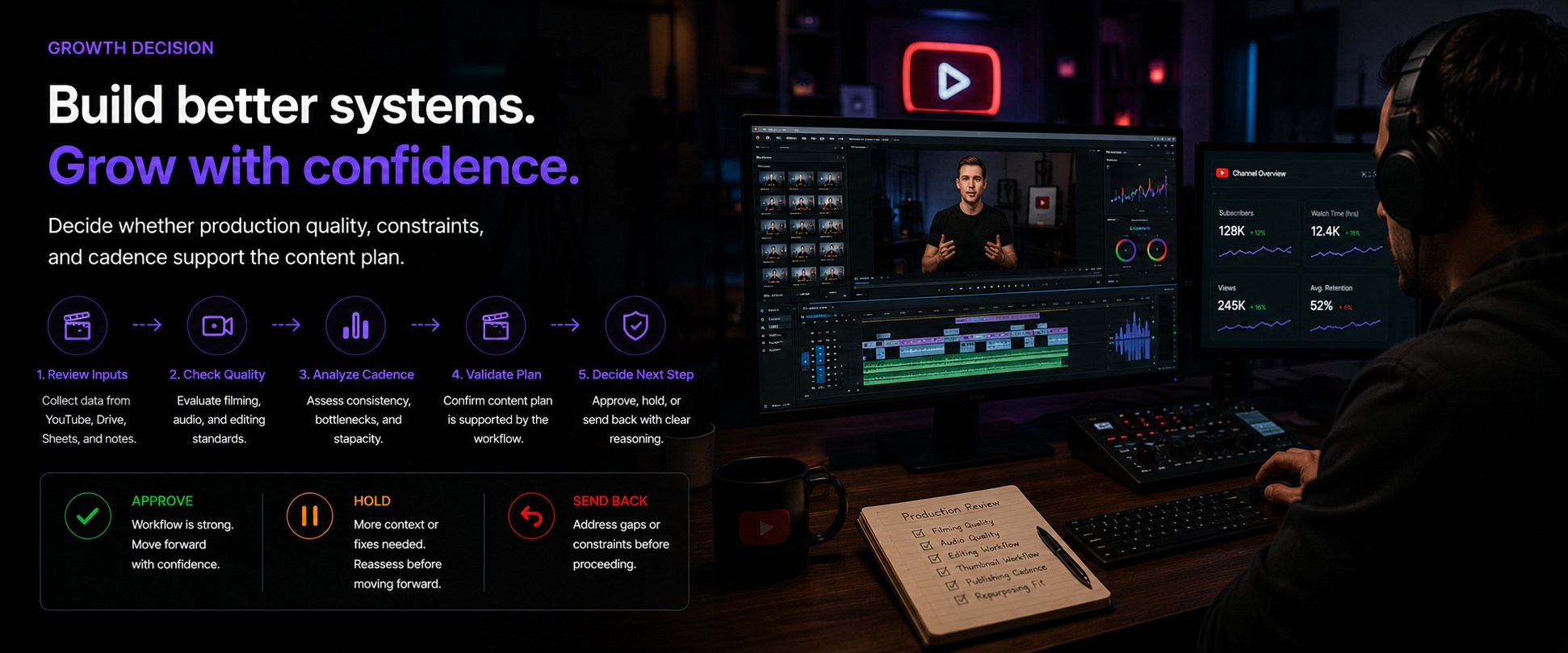
YouTube Production Workflow Review
Decide whether production quality, constraints, and cadence support the content plan.
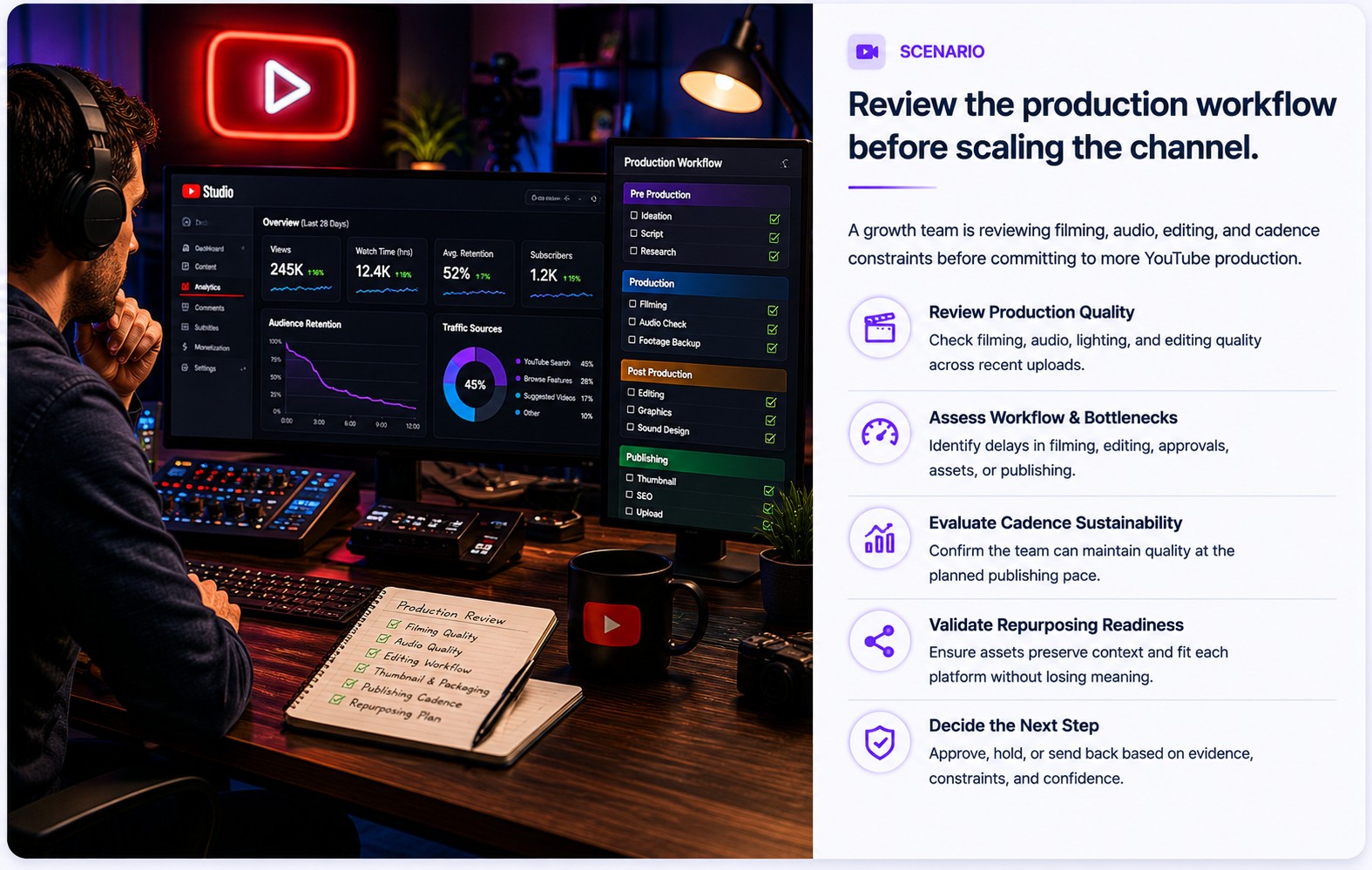
What this page helps a team decide
A growth team is reviewing filming, audio, editing, and cadence constraints before committing to more YouTube production.
- YouTube
- Google Drive
- Google Sheets
- operator notes
What analysts ask before deciding
What decision is the content marketer trying to make for youtube production workflow: approve, hold, or send back for evidence?
Which input would make the marketer trust the youtube production workflow read enough to change the publishing, packaging, or repurposing decision?
What caveat should stay visible before the team changes the publishing, packaging, or repurposing decision?
Who owns the next action if the review is approved, and what stays on hold if it is not?
What usually goes wrong
- The diagnostic workflow is treated as generic content instead of a growth decision.
- The recommendation skips the source caveat, so the next step looks safer than the evidence allows.
- Follow-up moves forward before the reviewer accepts the approval rule.
What 10x.in checks
- Review whether repurposed assets preserve the original context while fitting the channel where they will be used.
- Review whether the channel is focused enough for the audience and recommendation system to understand what the next video is for.
- Check whether social engagement is qualified enough to support follow-up.
- Check whether production constraints support or weaken the current content plan.
OpenAnalyst should review YouTube Production Workflow Review, compare the decision evidence with the caveats, and keep the next recommendation approval-gated until the reviewer accepts it.
FAQ
What mistake does the content repurposing quality check prevent?
For YouTube Production Workflow Review, this prevents a false-ready read: Repurposing should not turn a specific video into generic social filler; it should carry the useful decision, insight, or proof forward. The reviewer should hold the action when source context or platform fit is missing, keep the asset as a draft rather than scheduling it.
What mistake does the YouTube channel fit and audience focus check prevent?
For YouTube Production Workflow Review, this prevents a false-ready read: Weak YouTube growth can be a focus problem rather than a production-volume problem; the content lane may be too broad, unclear, or disconnected from the current audience. The reviewer should hold the action when audience fit or niche focus is unclear, recommend a content-lane review before increasing cadence.
What mistake does the social lead signal qualification check prevent?
For YouTube Production Workflow Review, this prevents a false-ready read: A social signal is useful only when it connects engagement to audience fit and a reviewable next step. The reviewer should hold the action when qualification is unclear, draft a review task before creating follow-up.
What should the reviewer approve after the checklist?
For YouTube Production Workflow Review, the reviewer should approve only the next step tied to YouTube channel fit and audience focus. If the required evidence for YouTube channel fit and audience focus is not visible, the output should be a hold note.
Can OpenAnalyst make the change automatically?
No. For YouTube Production Workflow Review, OpenAnalyst can draft the recommendation or follow-up, but execution stays approval-gated.
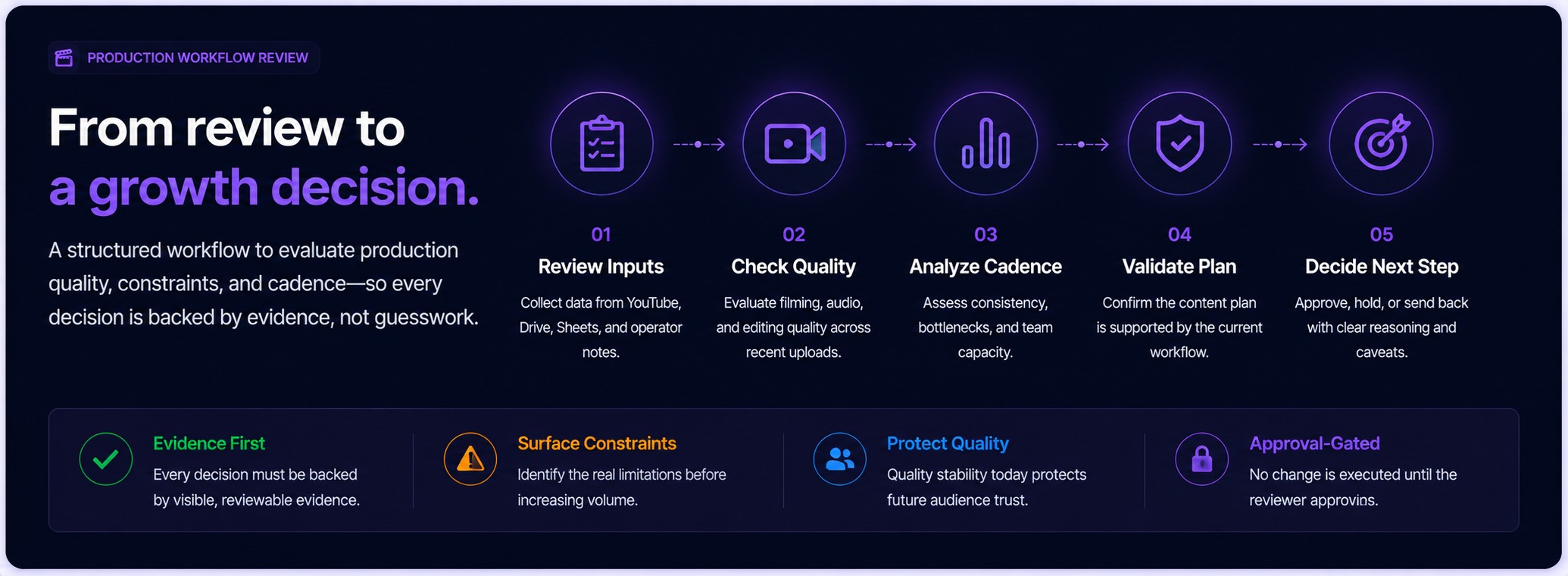
Why YouTube production workflow reviews matter
YouTube growth problems are often blamed on content quality, publishing inconsistency, or audience behavior. But many channel performance issues actually begin much earlier inside the production workflow itself.
Weak filming systems, inconsistent editing quality, delayed approvals, unclear repurposing processes, poor audio setup, unstable publishing cadence, or overloaded operators can quietly reduce content quality long before analytics dashboards show visible decline.
The YouTube Production Workflow Review exists to help growth teams identify whether production quality, operational constraints, repurposing readiness, or cadence limitations support the current content strategy before increasing output volume.
This workflow is not meant to produce generic productivity advice. The goal is to create a reviewable operational decision tied to evidence, constraints, caveats, and approval gates.
What this workflow helps decide
The workflow helps determine whether the team should:
- Increase production cadence
- Reduce production complexity
- Improve filming consistency
- Fix editing bottlenecks
- Change the repurposing process
- Pause scaling until workflow stability improves
- Adjust operational ownership
- Hold the publishing plan until production quality stabilizes
The reviewer should not simply approve "more content." The reviewer should identify whether the production system itself can reliably support the planned growth strategy.
Inputs required for the review
- YouTube: Publishing cadence history, retention trends, upload consistency, engagement quality, and format-level performance.
- Google Drive: Raw footage organization, editing handoffs, production assets, script libraries, thumbnail systems, and workflow documentation.
- Google Sheets: Production calendars, workflow trackers, editing queues, repurposing schedules, and operational readiness checklists.
- Operator Notes: Human context around filming constraints, editing delays, approval bottlenecks, quality concerns, and production capacity.
Step 1: Identify the production constraint
The first task is identifying which operational constraint limits the current workflow.
Many teams incorrectly assume the solution is more publishing volume when the real issue is editing overload, approval delays, inconsistent audio quality, weak scripting systems, or poor production coordination.
The reviewer should identify:
- Where production slows down
- What quality issue repeats most often
- Which handoff creates delays
- Which workflow stage creates operational instability
- Whether the current system can reliably support higher cadence
If the constraint is unclear, the workflow should remain partially held until additional operational evidence is reviewed.
Step 2: Review filming consistency
Inconsistent filming quality creates unstable audience experience. Even strong ideas can lose retention if lighting, framing, pacing, audio, or presentation quality varies significantly across uploads.
The reviewer should inspect:
- Audio consistency
- Lighting quality
- Camera framing
- Presenter delivery stability
- Visual clarity
- Recording workflow reliability
If production quality changes unpredictably between videos, the workflow may not be operationally stable enough for higher publishing cadence.
Step 3: Evaluate editing workflow quality
Editing systems influence pacing, retention, clarity, and publishing consistency. Weak editing workflows often create delayed publishing, rushed revisions, inconsistent hooks, or bloated runtime.
The reviewer should inspect:
- Editing turnaround time
- Revision frequency
- Approval delays
- Graphics workflow consistency
- Retention-focused editing quality
- Workflow ownership clarity
If editing bottlenecks repeatedly delay publishing, the issue may be workflow design rather than content strategy.
Step 4: Review publishing cadence sustainability
More publishing volume only helps when the workflow can maintain quality while scaling.
Many channels damage growth by increasing cadence too aggressively before stabilizing scripting, production, editing, review, and publishing systems.
The reviewer should determine:
- Whether deadlines are consistently missed
- Whether production stress is increasing
- Whether quality drops during higher output periods
- Whether operators are overloaded
- Whether the editorial calendar remains stable under pressure
If quality weakens as cadence rises, the correct action may be workflow stabilization rather than more production.
Step 5: Evaluate repurposing readiness
Repurposing workflows should preserve context while adapting content for different formats and platforms.
Many teams incorrectly transform useful long-form content into low-context short-form clips that lose clarity, usefulness, or audience alignment.
The reviewer should inspect:
- Context preservation
- Platform-specific formatting
- Message consistency
- Audience alignment
- Editing quality across formats
- Approval readiness before scheduling
If repurposed assets lose the original insight or positioning, the workflow should remain held until the content system improves.
Step 6: Review content-lane consistency
YouTube growth weakens when the production workflow supports too many unrelated content directions at once.
The reviewer should check whether:
- The production system supports a clear audience expectation
- Topics remain aligned with channel positioning
- The workflow reinforces niche consistency
- The editorial process protects audience trust
If the content lane is too broad, higher production volume may increase confusion instead of growth.
Step 7: Separate operational readiness from creative ambition
Creative ambition often exceeds operational capacity.
A team may want cinematic production quality, high publishing cadence, advanced editing, shorts repurposing, thumbnail testing, and multi-platform distribution simultaneously — but the workflow may not realistically support all of it.
The reviewer should compare:
- Planned complexity
- Available production capacity
- Operator bandwidth
- Editing throughput
- Review capacity
- Asset management stability
If operational readiness is weaker than the planned strategy, the recommendation should prioritize simplification before scaling.
Step 8: Identify workflow bottlenecks
Production bottlenecks often compound quietly over time. Small delays in scripting, editing, approval, or uploading can eventually destabilize the entire publishing calendar.
The reviewer should identify:
- Approval bottlenecks
- Editing queue congestion
- Thumbnail production delays
- Publishing coordination problems
- Asset retrieval issues
- Communication breakdowns
Once identified, the workflow should specify whether the constraint blocks growth directly or simply creates operational inefficiency.
Step 9: Separate quality constraints from quantity constraints
Some workflows fail because the team cannot produce enough content. Others fail because quality deteriorates during production expansion.
The reviewer should distinguish:
- Output limitations
- Quality instability
- Creative inconsistency
- Workflow fatigue
- Operator overload
- Scheduling instability
Increasing production without solving quality constraints often accelerates channel decline instead of fixing it.
Step 10: Decide what changes and what stays held
The final recommendation should clearly state:
- What production constraint matters most
- What evidence supports the recommendation
- What uncertainty still exists
- What should change immediately
- What should remain held until additional review
If multiple workflow constraints remain unresolved, the reviewer should explicitly keep the recommendation partially approval-gated.
OpenAnalyst should review YouTube Production Workflow Review, compare the decision evidence with the caveats, and keep the next recommendation approval-gated until the reviewer accepts it.
Failure modes this workflow prevents
- Scaling publishing cadence before stabilizing production quality
- Repurposing content without preserving context
- Overloading operators during growth periods
- Confusing audience problems with workflow problems
- Publishing inconsistent production quality
- Creating workflow instability through rushed scaling
- Expanding content complexity without operational readiness
- Weakening channel positioning through inconsistent production systems
Recommended decision outcomes
- Approve: The production workflow supports the planned cadence, quality level, and content strategy.
- Hold: The evidence is incomplete or operational instability could weaken future publishing quality.
- Send back: Workflow bottlenecks, quality instability, or production constraints require revision before scaling.
What should remain approval-gated
OpenAnalyst can draft recommendations, production reviews, operational summaries, workflow diagnostics, repurposing notes, and publishing guidance. Execution should remain approval-gated.
The system should not automatically increase publishing cadence, schedule uploads, approve production expansion, or restructure workflow ownership until the reviewer accepts the evidence and caveats.
Final workflow review checklist
- What production constraint limits the workflow?
- Is filming quality consistent enough for growth?
- Can editing workflows support the planned cadence?
- Does repurposed content preserve context?
- Is the production system operationally stable?
- Does the workflow reinforce niche consistency?
- Are operators overloaded?
- What bottleneck creates the most instability?
- Should production scale now or remain held?
- What action is approved and what remains gated?