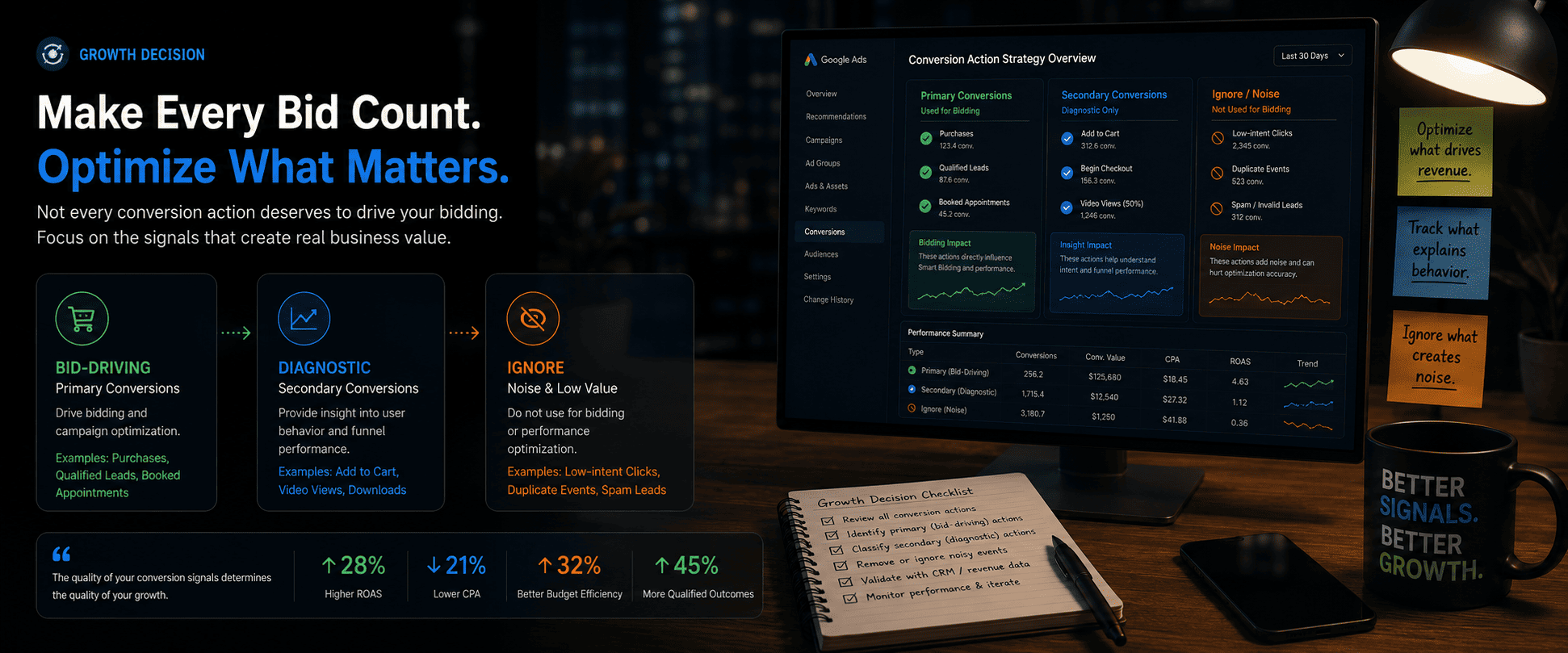
Primary vs Secondary Conversions for Campaign Analysis
Inside Google Ads, many tracked actions can look important. Purchases, lead forms, phone calls, add-to-cart clicks, newsletter signups, guide downloads, pricing-page visits, and engagement events may all appear in reporting. The problem is that not every tracked action should guide bidding, budget, or campaign decisions.
Primary vs secondary conversion analysis helps growth teams decide which conversion actions should guide bidding, which should remain diagnostic, and which should be ignored as noise. The distinction matters because Google Ads optimization becomes stronger when bidding is trained on signals that represent real business outcomes instead of easy, low-intent activity.
The goal is not to hide secondary signals. The goal is to use each signal for the right purpose: primary conversions for optimization, secondary conversions for context, and noisy events for review or removal.
What This Concept Decides
This review answers one practical question: which conversion actions are strong enough to influence campaign optimization? A conversion action should not become primary only because it fires often or looks useful in a dashboard. It should be tied to business value, revenue quality, or verified customer progression.
- Primary: Bid-driving events that represent meaningful business outcomes.
- Secondary: Diagnostic events that help explain user behavior but should not guide bidding by default.
- Ignore: Noisy, duplicated, low-intent, or poorly mapped events that may distort reporting.
- Hold: Events that need more evidence before being assigned to primary or secondary status.
What Primary Conversions Mean
Primary conversions are the actions Google Ads should treat as success events when optimizing campaign delivery. These are the outcomes that most directly connect to business performance. In ecommerce, this is often a completed purchase. In lead generation, it may be a qualified lead, sales-approved call, booked demo, or offline conversion imported from a CRM.
The key rule is simple: if the action directly represents business value and can be measured reliably, it may be a primary conversion. If the action only suggests interest, it should usually remain secondary until downstream evidence proves otherwise.
- Completed purchase
- Qualified lead submission
- Booked demo or consultation
- Paid subscription
- Sales-approved phone call
- Verified application or transaction
What Secondary Conversions Are Used For
Secondary conversions are useful for analysis, but they should not automatically guide bidding. They help marketers understand the funnel, diagnose behavior, and explain why campaigns are improving or weakening.
These signals can show intent, but they are not always business outcomes. A campaign optimized for add-to-cart may generate many carts without purchases. A campaign optimized for downloads may scale low-quality leads. Secondary events should stay visible in reporting while bidding remains focused on stronger outcomes.
- Add to cart
- Begin checkout
- Newsletter signup
- Guide download
- Pricing-page visit
- Video engagement
- Scroll depth or button interaction
Why Mixing Signals Creates Noise
When primary and secondary conversions are blended without structure, campaign learning becomes noisy. Google Ads may overvalue easier actions because they happen more often than the events that actually matter. This can make CPA look efficient while revenue quality declines.
This is why conversion classification should happen before campaign, budget, or creative decisions change. A strong-looking signal can still be attached to the wrong segment, unstable tracking, stale settings, or a recommendation no owner has approved.
- Newsletter signups inflate conversion totals without proving buyer intent.
- Add-to-cart events increase while checkout completion stays weak.
- Low-quality lead forms reduce CPA but weaken pipeline quality.
- Duplicate events make performance look stronger than it is.
- Engagement events distract from revenue or qualified lead outcomes.
Evidence To Review Before Assigning Conversion Type
The paid media lead should compare Google Ads settings with connected growth data before deciding what becomes primary. The evidence should show whether the action supports the exact decision being requested.
If connected evidence is missing, the event should stay caveated. The review should state what is observed, what is assumed, and what evidence would make the recommendation stronger.
- Google Ads conversion settings: Conversion action setup, campaign objective mapping, Smart Bidding configuration, and primary/secondary status.
- Google Analytics: Event tracking, engagement configuration, funnel progression, and post-click behavior.
- CRM records: Lead quality, sales acceptance, offline conversion imports, and lifecycle movement.
- Transaction logs: Purchase confirmation, revenue accuracy, refund context, and payment quality.
- Search-term reports: Query intent, CPA/ROAS history, and alignment between search behavior and conversion quality.
- Company context: Business model, margin, payback target, and what the team considers valuable.
Ecommerce Example
An ecommerce brand may track purchase, begin checkout, add to cart, email signup, coupon click, and product view. These actions should not all influence bidding equally.
This setup lets Google Ads optimize toward purchases while marketers still monitor supporting funnel signals.
- Purchase: Primary, if value, currency, and transaction data are accurate.
- Begin checkout: Secondary, useful for diagnosing checkout movement.
- Add to cart: Secondary, useful for product interest but not final value.
- Email signup: Secondary, unless the business has verified revenue quality from this path.
- Coupon click: Usually diagnostic or ignored if it does not support a decision.
Lead Generation Example
A lead generation account may track form submits, calls, pricing-page visits, guide downloads, and qualified sales outcomes. The strongest primary conversion is usually the event closest to verified business quality.
- Qualified lead: Primary when CRM evidence confirms quality.
- Sales-approved call: Primary when call quality and outcome are verified.
- Form submit: Primary only if lead quality is consistently strong; otherwise secondary.
- Pricing-page visit: Secondary, useful for intent analysis.
- Guide download: Secondary or diagnostic unless downstream quality is proven.
Approval-Gated Operating Rule
10X can compare the primary signal with supporting evidence and draft a recommendation, but follow-up should remain approval-gated. The memo should name which events are primary, which are secondary, why the distinction matters, and what confidence caveat applies before any account change.
- Approve primary status only when the event represents verified business value.
- Keep diagnostic events secondary when they explain behavior but do not prove outcomes.
- Ignore or clean up events that create noise, duplication, or weak optimization signals.
- Hold the change when ownership, tracking quality, or revenue evidence is incomplete.
Final Decision Rule
Google Ads performs best when conversion signals reflect real business outcomes. Primary conversions should guide bidding because they represent measurable value. Secondary conversions should remain visible because they explain behavior and help diagnose performance.
Before changing campaign settings, budget, or bidding strategy, the team should confirm that each conversion action is classified correctly. Clean conversion structure improves bidding accuracy, reporting quality, budget allocation, and confidence in the next marketing action.
Sample review note
10X should compare the primary signal with supporting evidence, name the caveat that could change the primary vs secondary conversions for campaign analysis recommendation, and keep follow-up approval-gated.